Categories
News Projects VIRTUOUS en

VIRTUOUS project Meeting in Thessaloniki, Greece 

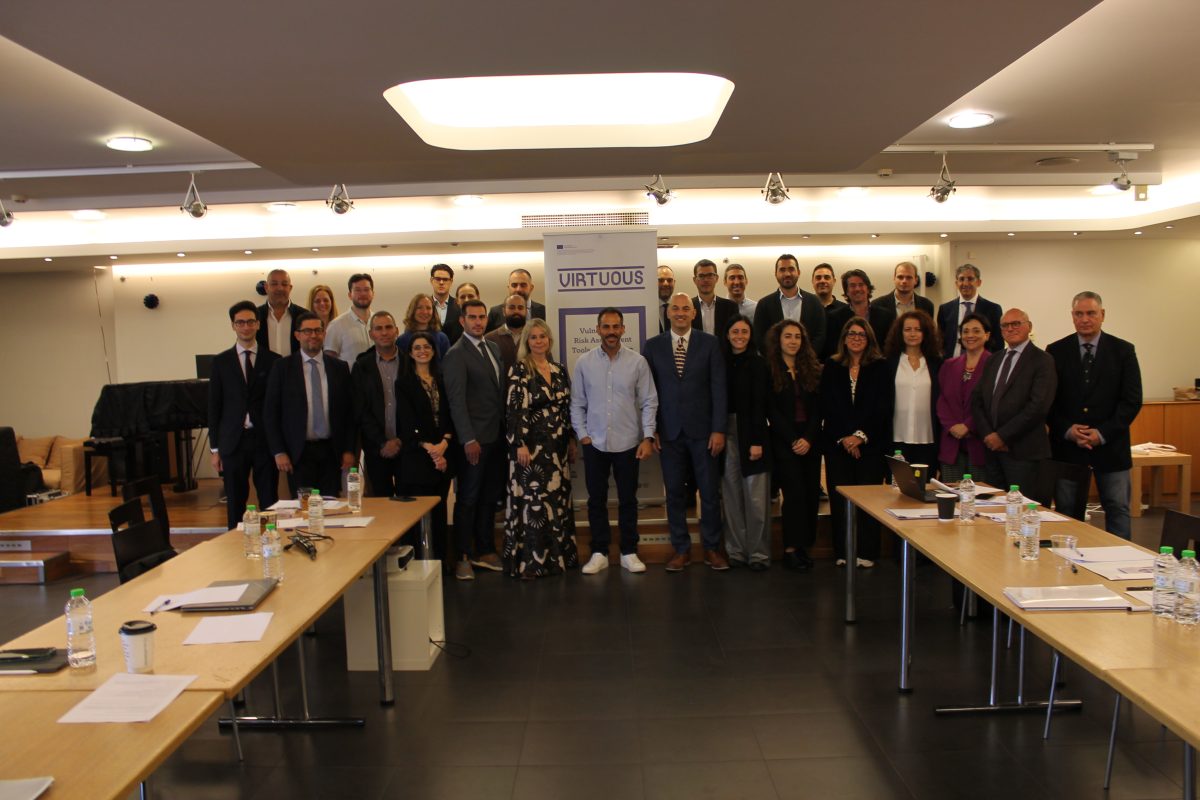
The Euro-Arab Foundation for Higher Studies recently participated in a transnational meeting of the VIRTUOUS project, held in Thessaloniki (Greece). During this meeting, the partners of this project – funded by the European Commission’s Internal Security Fund (ISF) – reviewed progress, shared knowledge, and planned the next steps to ensure the successful implementation of this initiative on the protection of places of worship.

A press conference was also held to showcase the project’s progress to local stakeholders, demonstrating its practical contribution to community security and collaboration across sectors. The press conference emphasized the project’s strong commitment to improving community security, fostering cooperation among the actors involved, and delivering tangible results across the participating countries.
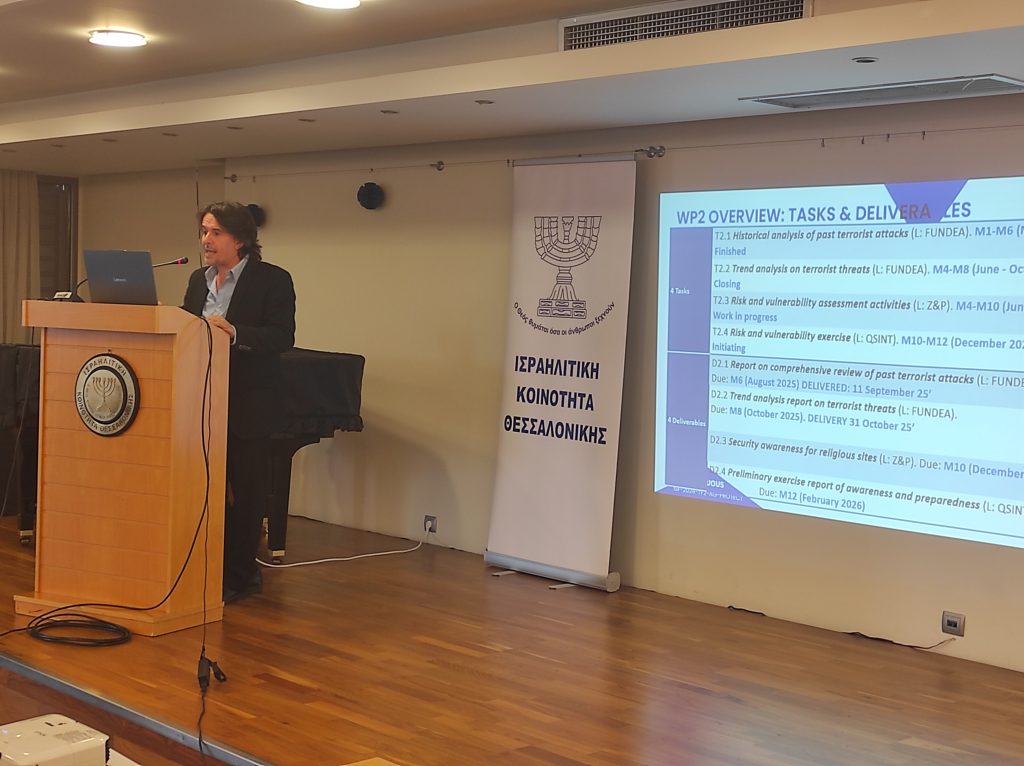
José Mª González Riera (Euro-Arab Foundation) during its intervention in the meeting

Professor Nikolaos Dimitriadis, President of the Center for Ecumenical, Apostolic, and Environmental Studies (CEMES), emphasized the symbolic and practical importance of protecting sacred spaces. “Places of worship represent not only faith but the foundation of peaceful coexistence. Thessaloniki has long been a city where Christians, Muslims, and Jews lived together harmoniously. Protecting these spaces is essential to preserving that legacy,” he stated. 

Likewise, the press conference highlighted that ensuring security in religious sites is not only about physical protection but also about strengthening resilience, fostering interfaith understanding, and maintaining public trust. A message of support from the Office of the Prime Minister of Greece further reinforced the importance of such initiatives. 

The VIRTUOUS Project continues to advocate for coordinated measures that combine faith, knowledge, and community engagement, showing that true security is built on collaboration and solidarity across religious and societal lines. 

Categories
EN Diversidad cultural EN Multiculturalidad News Projects

We Participate in the VII National Congress “Dismantling Islamophobia”

The Euro-Arab Foundation for Higher Studies reinforced its commitment to the fight against racism and discrimination by actively participating in the VII National Congress “Dismantling Islamophobia,” held on October 21 and 22 at the Faculty of Education of the University of Málaga.

The Congress, organized by the Moroccan Association for the Integration of Immigrants, brought together experts, academics, and activists to analyze the complex manifestations of Islamophobia in Spain and Europe, and to propose effective strategies for its eradication.

The Euro-Arab Foundation’s participation, part of the activities of its Research and Projects Department, featured the double intervention of its experts, Rascha Albaba and Lucía G. del Moral.

Institutional Training as a Prevention Tool

The Euro-Arab researcher, Rascha Albaba, during her intervention.

The Euro-Arab Foundation researcher, Rascha Albaba, presented her paper titled “Institutional training: preventing Islamophobia from within”, highlighting the essential work of the Euro-Arab Foundation in providing specialized training aimed at various key actors:

  • Security Forces and Bodies: for a better understanding and management of diversity.
  • Civil Society and Experts: to strengthen their intervention capabilities.
  • Institutional Actors: at the state and European level.

This training addresses crucial topics such as Islamophobia, interreligious dialogue, intercultural coexistence, and human rights.

Albaba emphasized both the activities developed within the framework of European projects and the Foundation’s own initiatives, stressing the accumulated experience of its experts and the solid institutional connections of the Euro-Arab Foundation.

Furthermore, the expert underlined the importance of human rights mechanisms as fundamental vehicles for transferring Spain’s situation regarding Islamophobia to the international sphere, using political and international dialogue as a crucial method for prevention.

The Euro-Arab researcher, Lucía G. del Moral, during her presentation.

For her part, Lucía García del Moral participated in the panel dedicated to analyzing institutional Islamophobia, with a paper titled “From Theory to Practice: European projects that transform the institutional response to Islamophobia.”

The participation of the Euro-Arab Foundation in this important national forum reaffirms its commitment to promoting the values of tolerance, diversity, and respect for human rights, and its active role in the fight against all forms of discrimination.

Categories
News Projects victory

Online training on hate, extremism and victim-centred solutions

The European project VicTory Project – Restorative and victim-centred approach to mitigate hate and (violent) extremism, in which the Euro-Arab Foundation takes part as a partner, is developing two free online courses adapted to the most up-to-date knowledge and current challenges, to train professionals who support victims of hate and extremism.

The objective is to ensure that professionals working with cases of hate and extremism —including law enforcement, judicial personnel, prison and probation staff, case managers, and victim support staff— can implement a victim-centred approach, applying effective techniques and legally sound procedures aimed at restorative justice. If you reside in Italy, Finland, Hungary, Portugal, or Spain, you can register via the link! Registrations from other countries are also accepted.

Register here: https://lnkd.in/dFysTwaS

They will inform you of the course dates later.

Categories
IN2PREV-en News Projects

The Euro-Arab Foundation Presents the Ethical and Human Rights Work at the IN2PREV Project’s Final Conference

The Euro-Arab Foundation for Higher Studies participated in the IN2PREV Project’s Final Conference, held on October 1st in the Portuguese city of Porto, where 50 participants gathered to share and enhance the impact of this prevention initiative focused on promoting the successful inclusion of refugees and preventing their radicalisation.

The event took place at the Faculdade de Direito da Universidade do Porto and brought together experts and professionals from across Europe. The meeting facilitated discussions on refugee integration, public policy coordination, and ethical considerations in reception and support. The conference also included panels on hate crime, radicalisation prevention, and professional practices in social inclusion.

The Euro-Arab Foundation’s Contribution: Ethics and Human Rights

The Euro-Arab Foundation, through its researchers Lucía Alonso and Rascha Albaba, highlighted its role within the project, specifically in the areas of human rights and ethics, with the ethical and legal review of the FEVR-SES tool, which is designed to identify vulnerabilities related to radicalisation among refugees and asylum seekers in Europe, ensuring that its use respects current legislation and ethical principles.

Albaba and Alonso also discussed the work carried out with the Human Rights Based Guides, which ensure a human rights-based approach during the pilot phase of the IN2PREV project’s mentoring program, seeking to protect the dignity and rights of refugees and asylum seekers.

Key Results of the IN2PREV Project

The conference highlighted the most significant results of the IN2PREV project:

  • European Cooperation Network: A European network has been established to achieve closer cooperation between law enforcement and NGOs, and to exchange knowledge across countries.
  • FEVR-SES Tool: The FEVR-SES tool offers frontline staff a structured way to assess vulnerability to radicalisation.
  • Mentoring Program: A mentoring program provides practical guidance and stability to refugees and asylum seekers in the partner contexts of the project.
  • Training Offers: The project has also developed blended and online training offers that are already helping professionals strengthen their skills.

The day concluded with a roundtable on how these efforts are supporting frontline practice and cross-sector collaboration, showcasing first-person experiences on the impact of the IN2PREV project.

Categories
EN Hatedemics News Projects

Pilot Test of HATEDEMICS AI Tool in Coria del Río

Young people, teachers, and educators will gather next Thursday, October 23, at the Museum of Andalusian Autonomy in Coria del Río to participate in the pilot test of the HATEDEMICS project. This initiative, in which the Euro-Arab Foundation is involved, aims to develop tools to combat hate speech.


A Two-Session Day

The initiative will take place over the course of a day divided into two training sessions.

  • In the morning, from 10:00 to 13:00, the activity will be aimed at a young audience.
  • In the afternoon, from 16:30 to 19:30, the session will be specifically geared toward teachers and educators.

The event will offer attendees the opportunity to learn first-hand about the tools being developed to identify and confront hate speech in various contexts. This pilot is a key step in the implementation of the project, and its results will help refine the strategy and materials ahead of the official launch.

The Museum of Andalusian Autonomy, an emblematic site for Andalusian history and culture, thus becomes the setting for this important educational and social initiative, highlighting the importance of education and dialogue in the fight against hate.

Categories
EUKH EN News RADICALIZACION EN

The Euro-Arab Foundation Contributes to the European Research on Global and Geopolitics of Radicalisation

As part of its work at the European Knowledge Hub on Prevention of Radicalisation, the Euro-Arab Foundation is a member of the Research Secretariat for Thematic Panel 7, ‘Global and geopolitical factors and unwanted foreign influences’. Daniel F. Pérez García, a researcher and European projects manager, as well as a trainer on the prevention of radicalisation and violent extremism, is responsible for this secretariat task for a panel that examines how geopolitical factors and global dynamics drive radicalisation and extremism within the EU, particularly when unwanted foreign influences are involved.

The work of this panel, comprised of a group of experts from the academic, security, and political fields, focuses on offering evidence-based recommendations to member states to strengthen their proactive and reactive capacity against the external promotion of radicalisation. Thus, the panel analyses the influence of international and geopolitical events on extremist multi-ideological mobilisation in Europe, as well as influence and undesirable interference campaigns to strengthen radical groups in the EU.

The panel promotes dialogue among researchers, policymakers, and professionals to design strategies adapted to these emerging challenges, improve resilience, identify key players and their tactics, and evaluate the effectiveness of existing prevention instruments. It also facilitates cooperation with allied countries, such as those in the Mediterranean or the Western Balkans, and contributes to the EU’s Agenda for the Prevention of Terrorism and Violent Extremism.

“Preparing the Ground: Global Impact and Foreign Interference in the Prevention and Countering of Violent Extremism (P/CVE)” is the title of the first meeting that brought together members of this panel, and the final results can be consulted on this website.

Categories
EUKH EN News

The Foundation’s role in understanding the links between mental health and lone actors in the EU Knowledge Hub

The Euro-Arab Foundation actively participates in the analysis of mental health in radicalisation processes, investigating how these factors can lead a person to become a “lone actor.” While this has been a subject of study for some time, the EU Knowledge Hub decided to create a thematic panel of experts dedicated exclusively to deepening the understanding of individuals who act alone in European Union member states, their connections with other online actors and groups, and their relationship with mental health problems.

The Research Secretariat of this panel rests exclusively with a Euro-Arab team made up of researchers: Paula Cano Cruz, José Luis Salido Medina, and Soukaina Belkat. The main objective is to understand how to identify these individuals to prevent violent acts, clarifying the concept of “lone actors” to strengthen cooperation at the EU level. The work is based on existing research and addresses how lone actors become radicalised, the role of mental health in radicalisation, the connection between these individuals and the online world (including indicators for their identification), and the best practices for cooperation and prevention.

The Research Secretariat of Thematic Panel 5 rests entirely with this team from the Euro-Arab Foundation.

Paula Cano Cruz is a researcher at the Euro-Arab Foundation in the field of hate speech, ideologies, and extremist movements. Sukaina Belkat is also a researcher at the Foundation and has worked as a mediator. For his part, José Luis Salido, a researcher at the Foundation and project manager, specialises in radicalisation and extremist movements.

You can find more information on the European Knowledge Centre for the Prevention of Radicalisation page: Thematic Panel 5 – Lone Actors and Mental Health Issues.

Categories
News Projects VANGUARD

World Day Against Trafficking in Persons

Human trafficking involves the recruitment, transportation, transfer, harbouring or receipt of persons by means of threats, use of force or other forms of coercion, for the purpose of exploitation, which may be sexual, labour-related, or for the removal of organs, among others.

The United Nations General Assembly designated 30 July as World Day Against Trafficking in Persons in 2013, with the aim of mobilising resources and efforts to combat this crime and support victims.

The Euro-Arab Foundation is involved in projects funded by the European Commission, such as VANGUARD, which aims to break the chain of human trafficking from a human rights perspective and put survivors at the centre of policies.

Categories
EUKH EN News

The Euro-Arab Foundation, Member of the Research Secretariat on Ideologies and Conspiracy Narratives of the EU Knowledge Hub

The EU Knowledge Hub on Prevention of Radicalisation, a European Commission knowledge center, decided in June 2024 to create seven thematic panels composed of experts from research, academia, security, and politics who deal with extremism and radicalisation. These panels began operating in February 2025, collaborating to exchange ideas, share experiences, and develop concrete recommendations for EU member states.

One of these panels is Thematic Panel 1 on Ideologies and Conspiracy Narratives, which is co-led by two experts and focuses on understanding extremist ideologies, including new hybrid or fragmented ones, and the role of conspiracy theories in the radicalisation process. The Euro-Arab Foundation for Higher Studies is part of the Research Secretariat of this panel through Isabel Pérez Pérez, Communication Manager of the Foundation’s Department of Research and International Projects. Pérez uses her academic and professional experience in journalism to identify and dismantle extreme, conspiratorial, or manipulative ideologies, collaborating in institutional and academic forums to promote fairer, more critical, and less vulnerable narratives against hate and propaganda.

Addressing Radicalization and Conspiracy Narratives

Radicalisation is a complex process where individuals or groups adopt radical ideologies that justify violent or terrorist acts to achieve political goals or expand their ideology. In the EU, radicalisation has recently taken on connotations of hybrid, fragmented, or mixed ideologies, posing greater challenges to understanding their dynamics, origins, and evolution.

The Thematic Panel on Ideologies and Conspiracy Narratives analyzes how radical narratives spread digitally, their influence on recruiting and mobilising individuals, especially vulnerable youth, and examines threats such as jihadism, right-wing extremism, leftist tendencies, and viral conspiracy theories. Its key objectives include building an inventory of radical and conspiratorial narratives, identifying vulnerability factors, proposing effective preventive strategies, and defining legal and public policy frameworks to counteract these ideologies within EU member states.

So far, the Panel has held two meetings in May and July 2025, addressing topics such as how and why minors and youth are attracted to extremist ideologies, and the nexus between organized crime and extremism (how ideologies and conspiracy theories fuel the symbiotic relationship between crime and extremism).

The results of these meetings are publicly available on the thematic panel’s website.

https://home-affairs.ec.europa.eu/networks/eu-knowledge-hub-prevention-radicalisation/thematic-panels/thematic-panel-1-ideologies-and-conspiracy-narratives_en

Categories
ERAMUS KA ADULT en News Projects

The E+ Program organises a mobility workshop on project writing and management

The deadline to submit applications and participate in the E+ Program mobility How to write a European project? which will take place from August 2 to 12 in Amblar-Don, Italy, is now open. This stay will be hosted by Ines- Itinerari in Natura per un’ Educazione Sostenible and its main objective is to facilitate the exchange of knowledge and experiences on writing and managing European projects, focusing mainly on the Erasmus+ program.

Participants will not only be able to strengthen their own skills, but will also act as trainers, sharing knowledge, methodologies and good practices in the preparation of European proposals. This bidirectional teaching-learning interaction will strengthen institutional capacities, foster international collaboration and generate an impact at both individual and collective levels, by promoting a culture of active participation in initiatives financed by the European Union. The activity is co-financed by the Erasmus+ program and covers accommodation, food, insurance, travel and educational activity expenses.

To participate, send an email to: edesolidaridad[at]gmail.com