


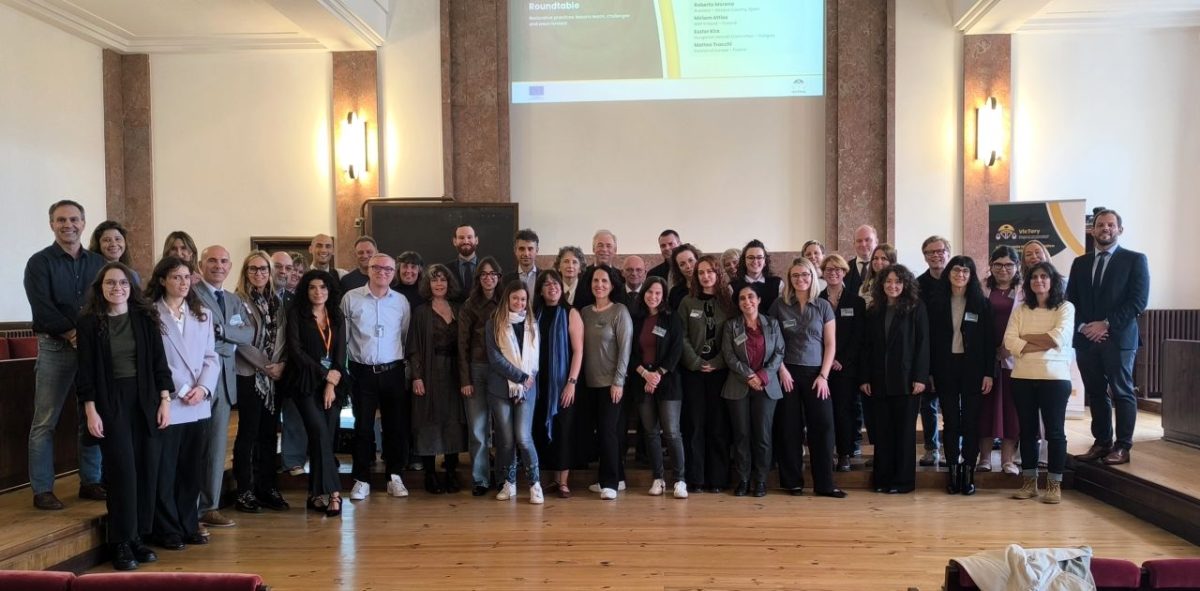
The Euro-Arab Foundation, coordinator of the VicTory project, took part in the final conference held on 22 October at the Faculty of Law of the University of Porto (FDUP) in Portugal, which marks the close of this European initiative. Over two years, VicTory has worked to change the way hate and extremism are addressed, placing at the centre those affected, whether directly or indirectly, and promoting a restorative, victim-centred approach.
The Foundation was represented by Daniel F. Pérez Garcia, research and projects coordinator, and Rascha Albaba Acosta, projects and research manager, both members of the VicTory team. Pérez took part in the consortium’s welcome and in the closing session, while Albaba presented Session I, dedicated to the victim-centred approach to hate and extremism: the project’s methodology, what was found and the experiences gathered. The session included a discussion panel with representatives of the European Forum for Restorative Justice, V Europe and Victim Support Europe.
The event brought together consortium partners, experts and professionals from across Europe, and opened with a keynote speech by Carolina Gómez of the Spanish Ministry of the Interior on the importance of European and international cooperation in supporting victims of terrorism. Throughout the day, the project’s main results were presented, including the training approach and its trained and certified participants in Italy, Finland, Hungary, Portugal and Spain, and the role of restorative justice as a response to hate and extremism was discussed.
The following day, Friday 23 October, the consortium held its final meeting, which addressed the project’s main results and the strategies for transferring and sustaining the training and awareness-raising programmes.
Main results
The VicTory research, which involved 196 professionals, found that only 3.2% consider the current legal provisions on victims’ rights to be highly effective. Professionals and victims agree on the need for more specialised training, better coordination between institutions, and clear and accessible information. Restorative justice is a priority need for 42.9% of victims, yet it is one of the forms of support least often offered.
In response, VicTory has produced a handbook of good practices and a training approach comprising two online courses, available in five languages, and three in-person events in Brescia, Budapest and Helsinki. Trained and certified participants in Italy, Finland, Hungary, Portugal and Spain raised their scores from 72% to 83%, and 96% of those who attended the in-person events believe that what they learnt will improve their work. The courses will remain open and free of charge after the project ends.
In the discussion on restorative justice, 87.3% of the professionals consulted supported it as a complement to formal justice, always with safeguards and specific training.
VicTory’s legacy in Spain, with the Euro-Arab Foundation
VicTory has been carried out by a consortium made up of the Euro-Arab Foundation, IPS (Innovative Prison Systems), the Faculty of Law of the University of Porto, the Ararteko (Ombudsman of the Basque Country), Associazione Carcere e Territorio, ILGA Portugal, MAP Finland and the Hungarian Helsinki Committee, and has been co-funded by the European Union.
In this context, the Euro-Arab Foundation has disseminated the VicTory Inclusive Digital Repository, which centralises knowledge on the support of victims of hate crime and extremism. In addition, on Tuesday 19 May 2026, the Historical Archive of the Basque Country, home to the Gogora Memorial Centre in Bilbao, hosted the event “Victim-centred justice and its contribution to coexistence in the Basque Country: experiences from the VicTory Project”. Furthermore, on Tuesday 4 March 2025, the seminar “Women and Restorative Justice: reparation from a gender perspective” was held in Granada, organised by the Euro-Arab Foundation in collaboration with the Ararteko, the Ombudsman of the Basque Country.
More information at www.victoryproject.eu.


