Categories
News VANGUARD VANGUARD

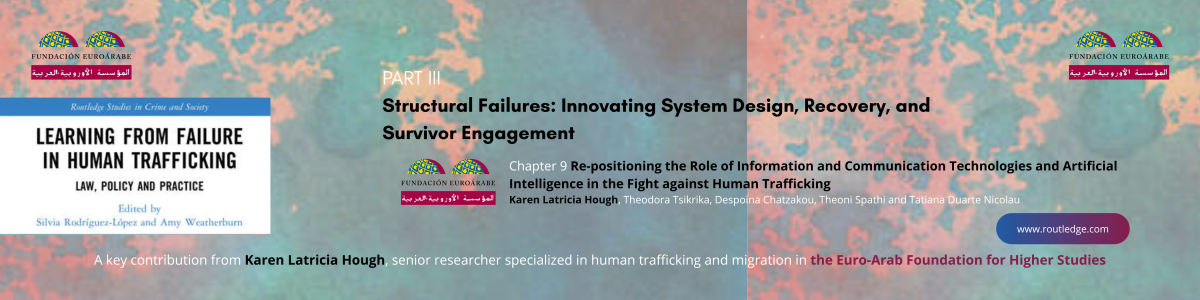
Karen Latricia Hough, VANGUARD project’s researcher, contribute to the volumen ‘Learning from Failures in Human Trafficking’

Hough co-authors chapter 9 ‘Re-positioning the Role of Information and Communication Technologies and Artificial Intelligence in the Fight against Human Trafficking’

Karen Latricia Hough, senior researcher at the Euro-Arab Foundation for Higher Studies currently developing VANGUARD project, has analyzed the importance of information and technological advances—such as artificial intelligence—alongside fellow researchers Theodora Tsikrika, Despoina Chatzakou, Theoni Spathi, and Tatiana Duarte Nicolau.

The article co-authored by Hough, Tsikrika, Chatzakou, Spathi, and Duarte Nicolau constitutes Part III of a publication supervised by Silvia Rodríguez-López, a senior researcher in criminal law at the University of A Coruña, and Amy Weatherburn, an FWO Senior Postdoctoral Fellow at the KU Leuven Institute for European Law, specializing in human trafficking, forced labor, migration, and fundamental rights law.

A collection published by the prestigious Routledge, structured around three core pillars

This monograph lays the groundwork for a paradigm shift in the anti-human trafficking literature, identifying where current approaches fall short and how these shortcomings might be addressed. Its approach is accessible and multidisciplinary, bringing together academics and legal practitioners to identify critical gaps in global response systems.

The volume is structured around three foundational pillars. The first part challenges outdated definitions of exploitation, particularly with regard to the criminal exploitation of minors, sex work, and labour trafficking. The second evaluates operational failures in victim identification and protection, drawing on recent, real-world case studies from across different continents, including cross-border drug smuggling in Chile, cyber-scam compounds in Southeast Asia, and the high-profile case of Dominic Ongwen at the International Criminal Court. Finally, the monograph turns to structural failures, highlighting the role of artificial intelligence in the fight against human trafficking, as well as the importance of integrating survivor testimony and lived experience into research, legislative, and policy-making processes.

The ultimate aim is to analyse why past measures have failed and to provide actionable, evidence-based, survivor-centred solutions to redefine future legislation, policy, and practice worldwide.

Categories
News VANGUARD VANGUARD

Red Flags: a serious game against child trafficking developed by VANGUARD

Accessible online for all audiences

The VANGUARD project, focused on developing technological solutions against human trafficking, has launched the game ‘Red Flags’, whose development involved the Euro-Arab Foundation in the design and oversight of the content script, a key piece given that it is an interactive, role-based game built around a series of dialogue sequences.

VANGUARD is a highly innovative, interdisciplinary project running over three years, involving a total of twenty-two partners from twelve countries, and backed by €4.5 million in funding. Part of this budget has been allocated to ‘Red Flags’, a serious game that adopts an engaging format prioritizing broad, straightforward accessibility aimed at social and educational professionals as well as parents and adolescents.

The goal is to educate people about one of the most common strategies used to recruit victims: the ‘loverboy’ method and the ‘love bombing’ tactic, which use supposed romantic relationships to attract, persuade, and ultimately subdue those who end up in a situation of risk until they are sexually exploited.

A campaign against the recruitment of minors through social media

The ‘Red Flags’ campaign has been designed for social media with one of the groups at highest risk of being recruited online in mind: adolescents and minors. Using accessible language, an informal style, and a series of short videos shared on the channels that are part of this population segment’s everyday life, ‘Red Flags’ is being introduced to young people in Spanish, English, German, Italian, Portuguese, and Greek.

Categories
EN Unchained News Projects VANGUARD VANGUARD

VANGUARD: Reinforcing the fight against THB

Twenty-two organisations from twelve different countries joined forces for a new Research and Innovation EU project, VANGUARD (adVANced technoloGical solutions coupled with societal-oriented Understanding and AwaReness for Disrupting trafficking in human beings).

VANGUARD is a three-year project, funded by the European Union under the Horizon Europe programme, which aims to strengthen the fight against trafficking in human beings (THB), at the nexus of advanced technological solutions of understanding, awareness raising, and training to disrupt the trafficking chain (online and offline) at an early stage and to address the culture of impunity. In addition, it aims to provide an improved intelligence picture of THB, with particular focus on THB for purposes of sexual exploitation, labour exploitation, and forced criminality.

This will be achieved through developing a modular and trustworthy suite of tools for detecting, identifying, investigating, and preventing online-facilitated THB activities and THB-related activities at (border) checkpoints based on the analysis of online multimedia content and multimodal streams, by leveraging the latest advancements in Artificial Intelligence (AI).

CERTH-ITI, and in particular the Multimodal Data Fusion and Analytics Group (M4D), being the Coordinator of the VANGUARD project, together with the Visual Computing Lab (VCL) of CERTH-ITI, hosted the two-day kick-off meeting of the project on November 7 and 8, 2023 at their premises in Thessaloniki, Greece. More than 30 attendees representing all the partners from research and academic institutions, technology-oriented companies, and civil society organisations, as well as Police and Border Guard Authorities, had the opportunity to set up a clear action plan for the upcoming months, thus facilitating the fruitful and successful implementation of VANGUARD objectives. The kick-off meeting was also attended by the European Commission Project Officer who welcomed this attempt, underlining in parallel the need for continuous collaboration and a multidisciplinary approach to effectively tackle THB behaviours, resulting in effective policy making initiatives.

The Consortium

Coordinator: CERTH (EL); Partners: GGMH (DE), UCSC (IT), WAT (PL), KU Leuven (BE), ΚΕΜΕΑ (EL), CEA (FR), ICCS (EL), FUNDEA (ES), ENG (IT), ATOS IT (ES), ITTI (PL), RAD (RO), BayHfoD (DE), MJ (PT), MCH (ES), GPI (MD), HELLENIC POLICE (EL), EPBGB (EE), RBP (RO), GIBP (MD), CENTRIC (UK).

Categories
News Projects VANGUARD

VANGUARD launches its efforts aimed at combating human trafficking

The VANGUARD project focuses its efforts on advanced technological solutions, combined with actions to raise awareness and understanding within society, aiding in the dismantling of human trafficking.

This week, on November 7th and 8th, the new European project in which the Euro-Arab Foundation participates, the VANGUARD project on human trafficking, was presented in Thessaloniki, Greece.

The VANGUARD project centers its work on advanced technological solutions, coupled with actions aimed at understanding and raising awareness within society to help dismantle human trafficking. Various interdisciplinary activities will be carried out throughout the program’s implementation, designed for the next three years, incorporating research and specific transfer and training actions.

VANGUARD, funded by the Horizon Europe Programme, is supported by a consortium of 22 organizations – universities, technological development centers, civil society organizations, and public authorities – from twelve European countries: Germany, Belgium, Spain, Estonia, France, Greece, Italy, Moldova, Poland, Portugal, the United Kingdom, and Romania. The Spanish partners in this project are the Euro-Arab Foundation, ATOS, and the Local Police of Murcia.

A team from the Projects Department of the Euro-Arab Foundation attended the sessions in Thessaloniki, including researchers José Riera and Karen Hough, and the head of the Projects Department, Javier Ruipérez. Ruipérez presented the different projects in which the Euro-Arab Foundation has been working in recent years on the specific issue of human trafficking, such as INTERCEPTED, UNCHAINED, or BIGOSINT.

Intervention by the Director of the Projects Department of the Euro-Arab Foundation, Javier Ruipérez, on Human Trafficking:

Trafficking in human beings (THB) is a serious transnational organized crime with diverse dynamics that can take various forms: trafficking for sexual exploitation is the most common form in the EU (60%), followed by labor exploitation (15%), while other forms include forced criminality, forced begging, organ extraction, forced marriages, and others.

Between 2008 and 2019, the number of identified victims of human trafficking more than tripled worldwide, and the total number of victims is much higher than recorded.

Human trafficking not only affects EU Member States but it also has a multidimensional international impact, violating the fundamental rights of individuals and creating security issues in all areas.

Almost 46% of trafficking victims are adult women, and 2 out of 10 are underage girls. Additionally, one-third of all detected victims are girls and boys, and 20% are adult men (UNODC, 2020). More than half of trafficking victims within the EU are EU citizens, and most are victims of internal trafficking within their own country.

As indicated by UNODC, traffickers take advantage of certain vulnerabilities of the victims, caused not only by personal factors but also by economic, social, and societal factors (for example, economic recession, COVID-19 pandemic, conflict-induced migration, etc.), targeting marginalized individuals in difficult situations.”