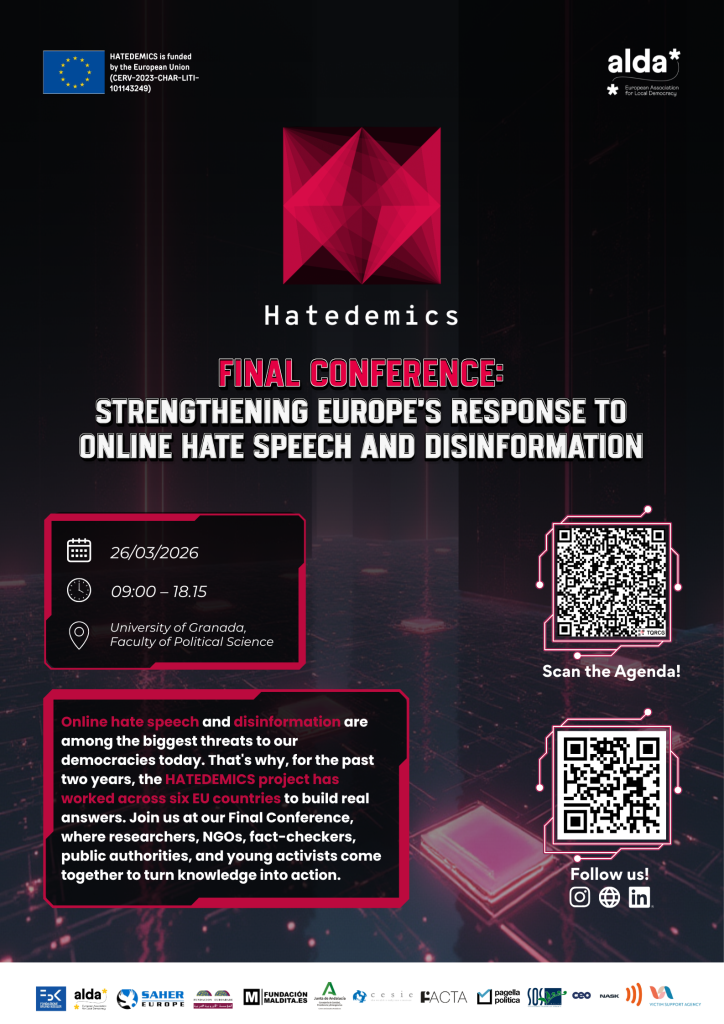
On March 26, the final conference of HATEDEMICS will take place in Granada under the title “Strengthening Europe’s Response to Online Hate Speech and Disinformation.” The event will be held at the Aula Magna of the Faculty of Political Science and Sociology at the University of Granada, from 9:00 a.m. to 6:00 p.m. It will be organized in a hybrid format (in person and online) and will bring together policymakers, academics, civil society organizations, technology professionals, young people, fact-checkers, and journalists, offering a unique opportunity to exchange perspectives and reflect on current challenges and future strategies at the European level.
This one-day conference represents a key milestone in the HATEDEMICS project’s efforts to address online hate speech and disinformation. By combining artificial intelligence and human expertise, the project has developed innovative tools to monitor, detect, and counter harmful narratives, while promoting ethical, inclusive, and democratic digital spaces.
The conference will present the project’s main results and will feature roundtables, presentations, and interactive workshops where participants will be able to test the AI-based tools created to detect disinformation and hate speech.
Registration to attend the event is now open and can be completed through this link.
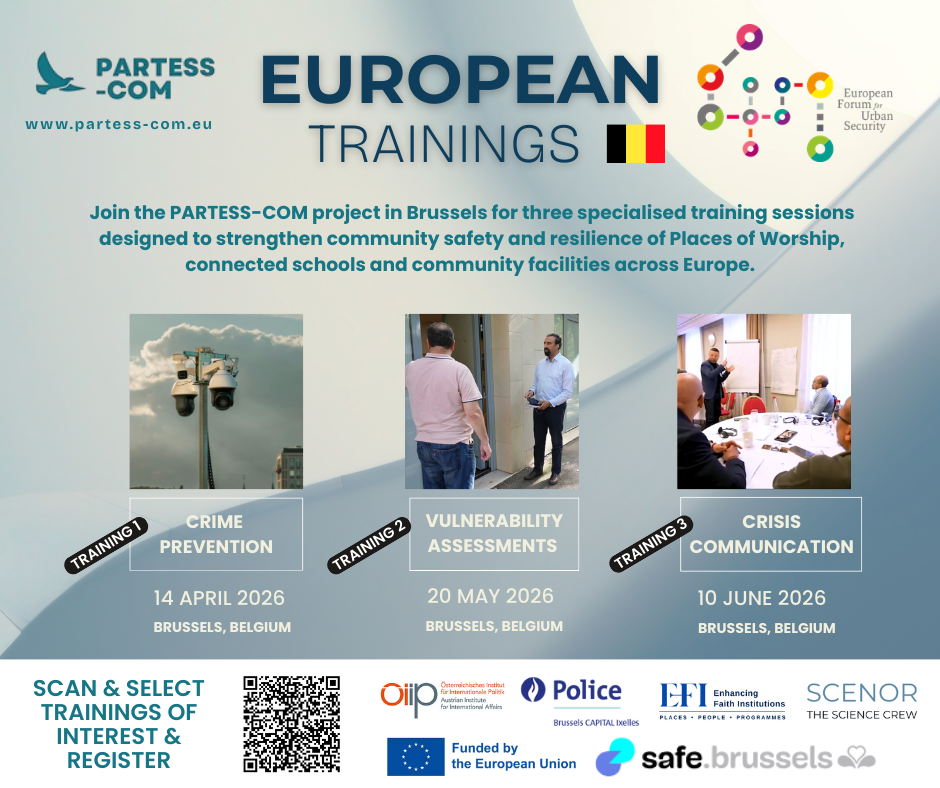
The PARTESS-COM project, in which the Euro-Arab Foundation participates, in collaboration with EFUS (European Forum for Urban Security) and with the support of the Brussels Police (PolBru) and safe.brussels, announces the launch of a series of European training sessions aimed at professionals interested in improving the security of public spaces and places of worship.
These training sessions aim to strengthen prevention, protection, and resilience capacities in the face of risks and threats that may affect gathering places and the public at large. The project promotes cooperation among local communities, authorities, and professionals to exchange promising practices and build effective strategies in the field of urban security.
The training series consists of three one-day in-person sessions to be held in Brussels throughout 2026:
From risk assessment to resilience: local crime prevention strategies for safer public spaces.
Protecting what matters: assessing and reducing vulnerabilities in places of worship.
Communication under pressure: managing communication before, during, and after a crisis.
The sessions will provide transferable tools and methodologies to develop approaches tailored to different environments and contexts, with particular attention to educational institutions and places of worship such as synagogues, mosques, or churches.
Practical information:
Session dates: April 14, May 20, and June 10, 2026.
Location: Brussels (Belgium).
Coverage: The project covers participants’ travel, accommodation, and subsistence costs.
Language: The sessions will be conducted primarily in English, with possible simultaneous interpretation into French.
Registration: Registration (via this link) does not guarantee participation. Final selection will aim to ensure balanced representation among stakeholder groups, geographical areas, and available places.
This training cycle represents a unique opportunity for local officials, law enforcement representatives, community leaders, and civil protection professionals to update their knowledge and share experiences in a European context.
The MALDITA Foundation, the Andalusian Centre for Studies, and the Euro-Arab Foundation for Higher Studies are co-organising the event “Internet in 2026: Disinformation, Polarization and Hate”, which will take place free of charge at the Palacio de la Prensa in Madrid on 19 February. The event is part of the European project Hatedemics, funded by the European Union, and brings together civil society organisations, experts and academics to discuss current challenges on the internet—such as the spread of hate speech and polarising content—and to explore possible solutions.
This Wednesday, 17 December, the headquarters of the Euro-Arab Foundation hosted the first meeting of the Local Working Group on the Protection of Places of Worship in Granada, a new platform arising from the joint work of the Euro-Arab Foundation and the Granada City Council, with the aim of enhancing the security of religious spaces and communities in the city.
The creation of this Working Group is part of the SHIELDed project, co-funded by the European Commission under the Internal Security Fund, in which the Euro-Arab Foundation participates alongside various partners. This first meeting brought together representatives of Granada’s main religious communities, civil society organisations, academia, and members of the State Security Forces and Corps.
During the meeting, opened by the Executive Secretary of the Euro-Arab Foundation, Antonio Sánchez, and the Councillor for Social Policy, Family, Disability and Older People of the Granada City Council, Amparo Arrabal Martín, the objectives and lines of action of the SHIELDed project were first addressed. Key municipal initiatives were also presented, such as the Municipal Participatory Round Table for Religious Diversity, the Municipal Round Table for Intercultural Dialogue, and the Municipal Observatory against Hate Crimes. These presentations were delivered by Councillor Amparo Arrabal Martín and by the Technical Director and Coordinator of both Municipal Round Tables, María Eugenia Luzón Molero.
The session concluded with a participatory exercise that allowed members of the Working Group to share and express their views on the security of places of worship in the city. Through this exercise, threats, protection needs, challenges, and existing good practices were identified, with the aim of laying the foundations for an action plan to guide the work of the group and define security priorities for religious communities and the institutions involved.
The Euro-Arab Foundation highly values the outcome of this first meeting, highlighting the high level of engagement, interest, and willingness shown by all participants. It also thanks the Granada City Council and the participating organisations for their close collaboration, expressing confidence that this line of joint work will be consolidated over time and that this Working Group will become a useful forum for strengthening coexistence, peace, and security in the city.
On June 16, the PARTES project culminated in its final conference in Vienna, gathering researchers, faith-community representatives, and security experts. Over its two-year duration, the project focused on protecting places of worship. It was made possible by financial support from the European Commission’s Internal Security Fund (ISF) and saw fifteen partners from ten European countries collaborate on this vital initiative.
The European Commission’s DG Home’s representative underscored the crucial role of Union Actions projects, like PARTES, in tackling transnational issues affecting the entire EU. At its core, PARTES aimed to bolster the protection of places of worship by fostering a deeper understanding of violent extremism and its potential impact. Its six key objectives included mapping threats, assessing vulnerabilities, and facilitating the exchange of best practices among diverse religious communities.
A critical aspect addressed was online threats, with a presentation by SCENOR detailing how extremist organizations exploit digital platforms to spread right-wing hate. This analysis revealed a significant shift in strategy: unlike in the past, these groups now actively conceal their true ideologies and objectives by masking their hate. This tactic allows them to evade moderation and reach a broader audience.
The project also introduced the “PARTES Guardian approach,” which prioritizes engaging faith communities and incorporating their concerns to ensure protective measures are culturally and spiritually appropriate. To further support these efforts, PARTES developed 23 “action sheets” – practical, step-by-step best practices gathered from 10 partners, covering areas like interfaith dialogues and mental health crisis guidelines. The conference concluded with acknowledgements to the dedicated team members, technicians, and security personnel who contributed to its success.
Euro-Arab Foundation Article Highlights Rising Vulnerability to Hate Crimes
During the final event of PARTES, the Euro-Arab Foundation, José Luis Salido Medina, exposed the results of his research on Extremism and Places of Worship: Analysis of Strategies and Ideological Motivations,conducted as part of the project. The article examines the increasing vulnerability of religious communities to hate crimes driven by extremist narratives. It presents findings from an analysis of 25 case studies of hate crimes and violent attacks across 13 European countries. The research delves into the ideological and strategic characteristics of extremist groups involved, considering factors such as the perpetrator’s ideology, the nature of the attack, online/offline dimensions, and the presence of manifestos.
The final event of the PARTES project marked a significant milestone, signalling its transformation into PARTESS-COM. This evolution is a testament to the substantial work accomplished and the robust networks established during the project’s tenure.
On April 30, the seminar ‘Spirituality, youth and gender in the 21st century’ was held at the Euro-Arab Foundation. Its main objective was to provide a space for women and young believers of different faiths to share their experience of how they live their spirituality today. The seminar was moderated by Soukaina Belkat and José Luis Salido Medina, researchers at the Euro-Arab Foundation, and was attended by members of Muslim, Catholic, Protestant and Buddhist faiths.
The activity, organised by the Euro-Arab Foundation in the framework of the European project PARTES, addressed a series of guiding questions on gender and current social dynamics. It was divided into two parts, one dedicated to the role of women in the different religions represented and the other to the experience of young people with their faith.
The role of women in religion
The round table ‘The role of women in religion’ was given by Lola Parras Chica, Tibetan Buddhist and former director of the Nagarjuna Buddhist Centre in Granada; Khatarina Zimmerhofer, Catholic and student of Theology; Zoraida Ali Morell, Muslim, philosopher and psychologist; and Eva Domínguez Sosa, pastor of the Protestant church of San Pablo in Granada, Spain, and Eva Domínguez Sosa, pastor of the Protestant church of San Pablo in Granada.
Lola addressed the situation of women in Buddhism, pointing out the persistence of patriarchal patterns in religions. These patterns are manifested in the allocation of gender roles, such as motherhood, the development of which is influenced by the socio-cultural context. Therefore, Lola argued that not all religious precepts should be accepted uncritically. She emphasised the importance of not naturalising maternal roles that deprive women of time for activities such as meditation. She advocated a stance of zero tolerance towards patriarchy, but devoid of hatred. Finally, she stressed that self-knowledge and deep understanding lead to enlightenment in three fundamental areas: ethics, conduct, concentration-meditation and wisdom.
Khatarina emphasised that baptism confers fundamental and equal dignity from birth. She then elaborated on the Ignatian principle of ‘seeing Christ in one’s neighbour’, explaining how this perspective invites us to recognise the inherent worth of each individual, transcending social or gender distinctions. In her analysis of women in the Bible, she highlighted the central figure of the Virgin Mary, whose role is crucial in the Christian narrative. In addition, she referred to the ‘three Teresas’: St. Teresa of Avila, a leading figure of mysticism and reformer of Carmel; the Venerable Servant of God Teresa de Jesús Jornet e Ibars, founder of the Little Sisters of the Disabled Elderly; and St. Teresa of Avila, founder of the Little Sisters of the Disabled; and St. Teresa of Avila, founder of the Little Sisters of the Disabled, founder of the Little Sisters of the Disabled.
Eva addressed critical feminisms and the perspective of intersectionality, pointing out that we live in a social reality deeply marked by patriarchy and with a significant Judeo-Christian heritage. In relation to the role of religion in the configuration of gender roles, she mentioned how historically some religions instructed women in the essential aspects of carrying out their purification rites, as in the case of Muslim practices. In contrast, she highlighted a significant moment in the Christian tradition where Jesus Christ gave a crucial role to Mary Magdalene by making her the first witness of his resurrection, sending her to announce this good news to the other disciples. This act challenged the social norms of the time and elevated one woman’s witness to a foundational position within Christianity.
Youth and religion. Experiences from today
The second round table “Youth and religion. Experiences from the present day” featured presentations by Isairis Valerio Domínguez, a Catholic and theology student, and Brahim Iguizol, a Muslim, sociologist specialising in anthropology and trends in Islamic thought.
Isairis began his intervention at the table on spirituality and young people by emphasising the importance of coherence between personal values and authenticity. She proposed that the daily examination of spiritual conscience, together with the experiences, should be cultivated in a space of recollection.
She underlined that a pluralistic society offers the valuable benefit of reasoned questioning. In this sense, she advocated ‘resuscitating’ those elements that favour individual spiritual freedom. Isairis contrasted polarisation with the need for deep internal dialogue, pointing out the importance of not giving in to hatred and the discourses that promote it, but embracing a freedom that opens us to connection with others. Finally, she stated that intolerance is rooted in fear, but that society must adopt a critical and reflective stance in order to overcome it.
Brahim suggested that returning to a space of recollection could generate a multiplicity of interpretations, thus encouraging a secular modernisation of spiritual understanding. He proposed the need for a contemporary spirituality that transcends traditional religious institutions, allowing individuals to experience the sacred directly and personally. He also highlighted how Islam can be a tool to combat arrogant selfishness, exploitation and abuse of power, promoting active participation in building a more just society. In his conclusion, Brahim emphasised the imperative need for dialogue, based on the humility to learn from others, in order to work together to solve global challenges. This dialogue requires a framework of equality, devoid of power relations and intolerance.He lamented the inadequacy of current trans-religious dialogue, calling for more interfaith learning and cooperation as a way to mitigate growing social polarisation.
PARTES will end next June
In response to the rising tide of attacks and hate crimes targeting places of worship in Europe and globally since 2023, the PARTES project has emerged as a crucial initiative. Mosques, synagogues and churches have become vulnerable targets, a situation that has been exacerbated by the rise of online hate crimes and cyber-attacks, sometimes intertwined with physical campaigns. These acts of violence are a reflection of a deeper extremist problem, fuelled by toxic discourses, a lack of intercultural and inter-religious understanding, and insufficient societal engagement in preventing extremism.
The seminar “Spirituality, youth and gender in the 21st century” represented the culmination of the project’s activities, preceding the closing event to be held in Vienna on 16 June.
A key achievement of PARTES has been the development of the “PARTES Guardian Approach”, a comprehensive prevention model designed to strengthen the security of places of worship across Europe and thus mitigate hate crimes affecting religious communities. The project has focused on key pillars such as the strengthening of cooperation between public authorities and religious communities, the implementation of awareness-raising campaigns, the organisation of specialised trainings and seminars, and the thorough evaluation and exchange of best practices and tools available in this field. A tangible result of this effort is the “Action Sheets” developed by the PARTES consortium, a valuable compilation of effective practices implemented in the European Union to optimise the protection of places of worship.
The European project PARTES, in which the Euro-Arab Foundation participates, has launched a new video to raise awareness of one of its main objectives: preserving places of worship as timeless symbols of faith, history and cultural heritage.
The PARTES consortium notes that in order to effectively counter security threats to synagogues, mosques or churches, it is essential to understand the underlying violent extremist phenomenon and its specific manifestations in relation to these targets. There is also a need to engage religious communities in policy and action and to educate the general public about toxic extremist rhetoric, but also about the specific characteristics and manifestations of the various faiths. To raise awareness on this issue, PARTES is publishing a series of videos that can be viewed on this Youtube channel.
About PARTES
The PARTES project started in 2023 and was born in a context of increasing attacks and hate crimes against places of worship in Europe and around the world. Mosques and synagogues are particularly affected, although Christian places of worship have also been targeted. The threat landscape has become even more complex with the growing number of online hate crimes and cyber-attacks, sometimes combined with offline campaigns.
These attacks are only a symptom of a wider violent extremist phenomenon that is on the rise in Europe, fuelled by toxic extremist rhetoric, ignorance of other religions and cultures, and insufficient involvement of society at large in preventing extremism. While the authorities provide some protection and security support, existing measures need to be strengthened and improved. The phenomenon needs to be addressed in a more complex way that goes beyond architectural security and police presence.
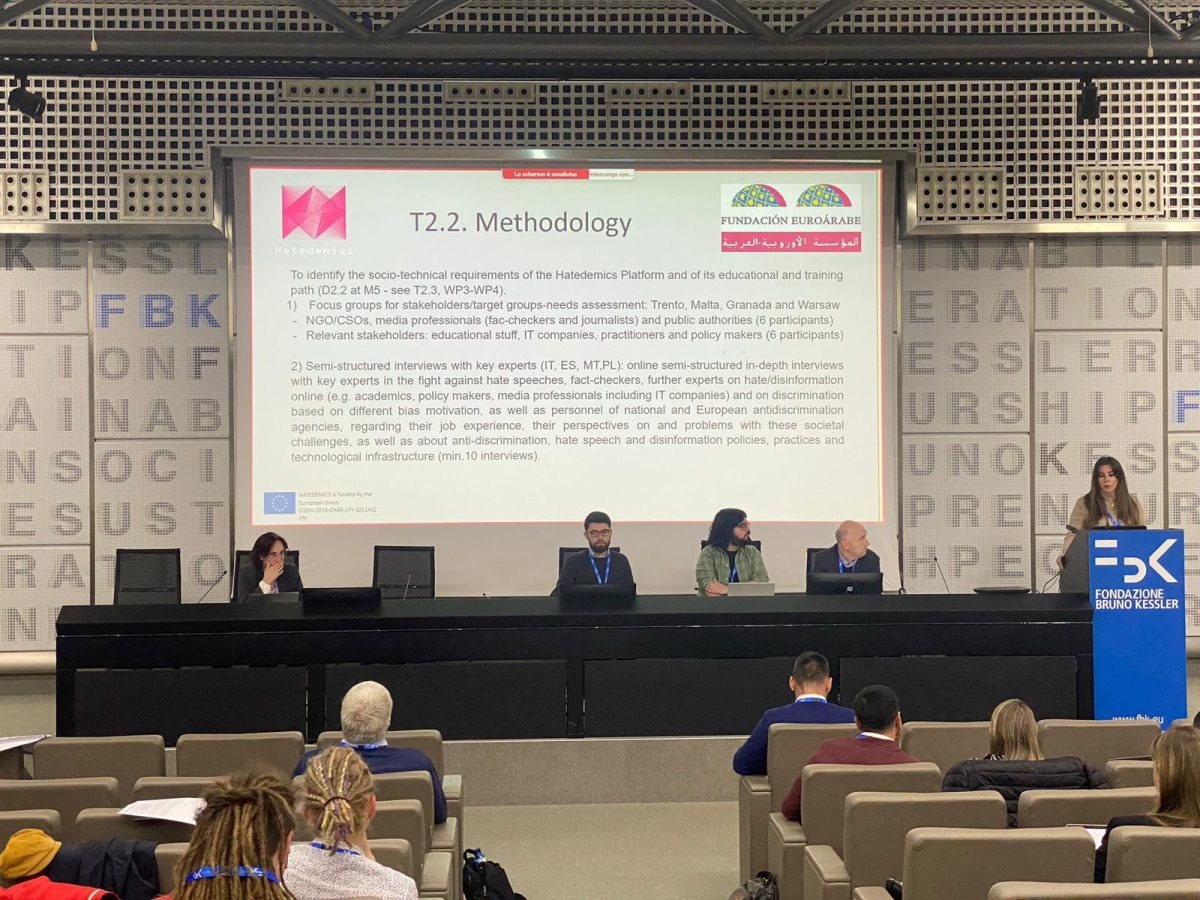
Lucía G. del Moral, researcher at the Euro-Arab Foundation and coordinator of HATEDEMICS at the foundation, speaks at the kick-off meeting together with researcher José Luis Salido.
On 17th and 18th April the Italian city of Trento will be holding the kick-off meeting of HATEDEMICS, a European Commission-funded project that put together fourteen partners with the objective of hampering hate speech and disinformation through AI-based technologies to prevent and combat polarisation and the spread of intolerant speech and conspiracy theories.
The project arises as a consequence of the rapid growth of social media platforms as facilitators of communication and interaction, but also as fertile ground for discrimination, hatred and misinformation with multiple targets. In this sense, during two years HATEDEMICS will address online hate and fake news, monitoring, detecting and recording. It will estimate the ‘hatedemics risk’ as the sum of the ‘hate speech and infodemics risks’ and, automatically assess behavioural changes.
The project will pilot and test a HATEDEMICS Platform, a tool that will be useful for NGOs/CSOs, fact checkers, journalists and media companies, as well as public authorities and youth activists to raise awareness of hate speech, and foster education through critical thinking and the ability to identify hate speech.
FUNDEA’S role in HATEDEMICS
The Euro-Arab Foundation for Higher Studies will be in charge of the research and support package to create the Platform, i.e. to prepare the HATEDEMICS methodology considering the current trends of hate speech, disinformation and multi-targeted discrimination [R1] online, as well as the requirements and needs of all stakeholders and target groups mentioned above. This will provide guidelines and approaches to engage all of them in the daily use of the advanced HATEDEMICS Platform and the development of a specific training and educational pathway. It will also facilitate the implementation of the pilot project, ensuring that the HATEDEMICS approach goes beyond the framework of the project and its end.