Categories
EN Bigosint EN Standup News

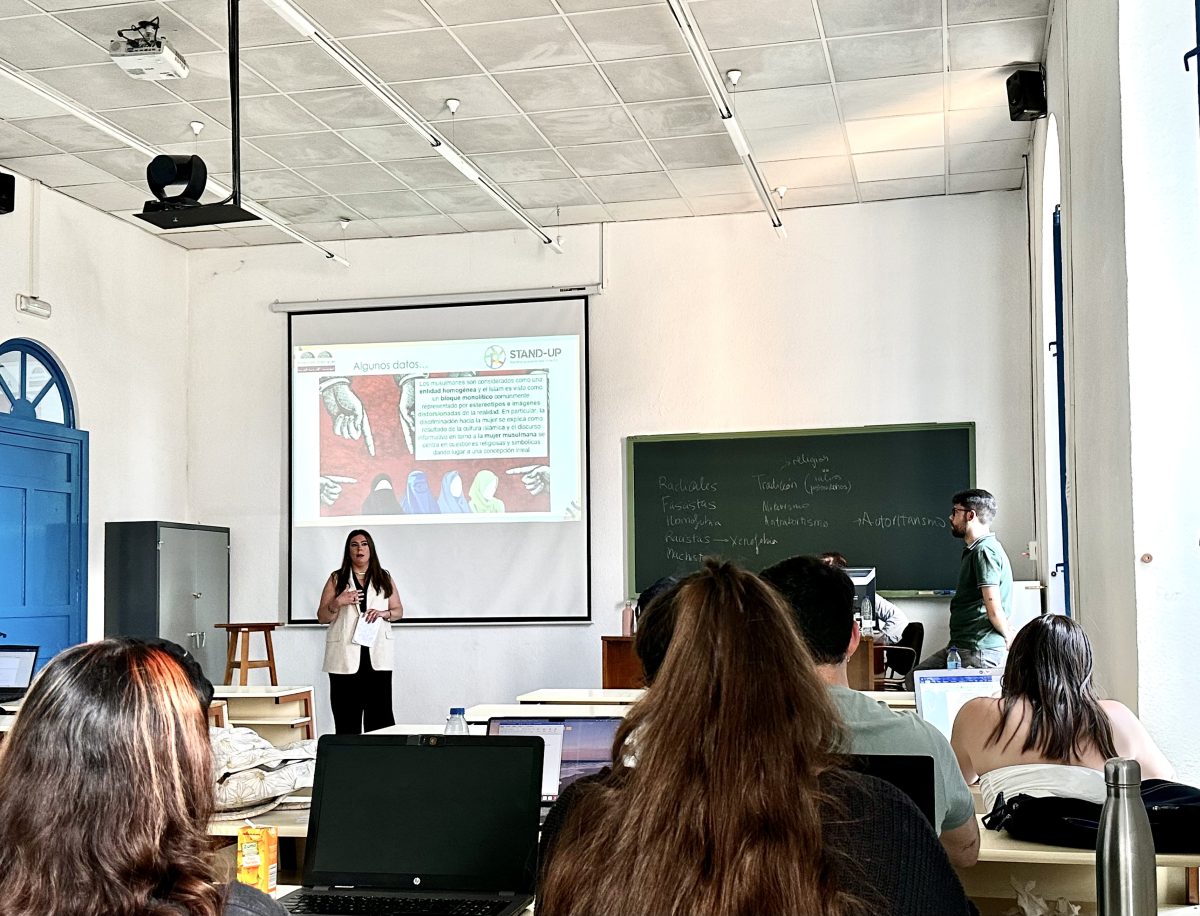
Virtual reality sessions and coordination of the BIGOSINT and STAND-UP European projects at the Euro-Arab

An important work agenda begins this morning at the headquarters of the Euro-Arab Foundation today and tomorrow, May 10 and 11, developed by the consortium of two European projects in which the Euro-Arab participates, the BIGOSINT project and STAND -UP.

The objective of this conference is to work on the training and coordination of the pilot tests that will be carried out, sharing the tools and platforms of these two projects financed by the European Commission, the BIGOSINT project, whose objective is to counteract Trafficking in Human Beings through the analysis of Big Data and Open Source Intelligence (OSINT) and the STAND-UP project that focuses its work on the fight against hate in the European Union.

In this sense, training in Virtual Reality will be held tomorrow in Granada. With it, it will be possible to support the understanding of the training methodology that both projects will apply in a later phase. This, in turn, will allow them to contribute to the development of the training content and its implementation in a more meaningful way.

This joint activity is expected to open the way to new collaborations with other projects financed by the European Union, those that share a similar research approach and training methodologies, as well as beneficiaries and the use of open source intelligence.

Categories
EN Medea

Researchers and security professionals meet to exchange solutions on the management of Migratory Flows.

The Euro-Arab Foundation is organizing an event within the H2020 MEDEA project, Network of Security Professionals in the Mediterranean and the Black Sea, which will bring together Security professionals and solution providers in the field of Migratory Flow Management.

This event will be held in English and online on Tuesday, May 3, 2022, from 9:00 a.m. to 5:00 p.m. CET.

To register for this event you can click here: https://ec.europa.eu/eusurvey/runner/MEDEA-RDI-TCP1-2022

In September 2021, the MEDEA consortium has launched an open call to Academia and Industry for Ideas and Solutions. on solving the identified gaps. The consortium has evaluated the proposals submitted and has selected those ideas that best address the different needs that arise in terms of security.

Some of the selected ideas will be communicated to potential solution providers and pioneers in security innovation. During the Research, Development and Innovation Day, responders to the open call (security stakeholders, industries, academia, research organisations and SMEs) will be able to present pertinent to MEDEA members and practitioners in high level of operational, solutions in the different areas covered by the project: management of migratory flows, border surveillance, cross-border crime and terrorism, natural risks and technological accidents.

The Euro-Arab Foundation coordinates the first thematic community of the project ‘Management of migratory flows and asylum seekers’ for which we have identified and documented several capability gaps. Through this event, we offer the opportunity to learn about new solutions for these gaps in the field of migration in the Mediterranean.

MEDEA is a Coordination and Support Action for the European Commission financed by the EU through the H2020 program whose objective is to establish and develop a regional network of professionals and other actors related to security in the Mediterranean and Black Sea region.

Categories
EN Hope

Deradicalization in the prison context in Norway

The partners of the HOPE project (Holistic Radicalization Prevention Initiative) have met this past March 31 and April 1 at the University Center of the Norwegian Correctional Service (KRUS) in Lillestrom, Norway. During the meeting, they learned about the international projects of the KRUS, which is currently an international reference organization. They also witnessed part of the practical training activities, talked with students and teachers of the university degree for people who want to work in the prison context, visited the training spaces and the library. The consortium meeting also served to update the status of the project and plan the next activities, which will include 3 trainings on deradicalization in the prison context for frontline professionals in Bulgaria, Slovenia and Serbia.

On Friday, April 1, the participants visited the Kongsvinger prison complex. The visit included a presentation of the prison deradicalization model used in Norway, whose main element is dynamic security. Dynamic security is based on close contact with prisoners, trust based on the creation of a personal relationship with them and risk analysis based on changes in behavior, rather than static indicators. During the visit, the partners had the opportunity to visit cells at the different security levels, the training and recreation facilities for prisoners and the training spaces for prison officials.

The European project HOPE, in which the Euro-Arab Foundation participates, is developing a network for continuous training and knowledge exchange in the Balkans and countries of southern and eastern Europe.

The HOPE project is developing a network for continuous training and knowledge sharing in the Balkan, Southern and Eastern European countries.

This network aims to intervene in radicalisation prevention and disengagement and improve the transition between the prison/probation system and the community, for those at risk of radicalisation or who have already been radicalised.

Training and research organisations, academics, prison, and probation administrations make up the HOPE project network.

This project is led by IPS Innovative Prison Systems, and is funded by Iceland, Liechtenstein and Norway through the EEA-Norway Grant Fund for Regional Cooperation.

Categories
EN Mirad News

A Call to Join the MIRAD Expert Board

MIRAD overview 

MIRAD is an 18-month project co-funded by Internal Security Fund. MIRAD’s main goal is to build upon IRS (Individual Radicalisation Screening)[1] and develop specific, add-on ideological-centred assessment sheets to the IRS, having in consideration two different extremist typologies: right-wing extremism and Islamist extremism. For MIRAD, the role of gender is important as well. The MIRAD project also aims to train practitioners from prison, probation, and non-governmental organisations via e-learning and virtual-reality scenarios. In addition, the project foresees the development of an instrument to assess the trustworthiness and capability of NGOs that work with extremist/radical individuals, which could later be used by prison and probation systems in the EU.

The idea behind Expert Board

To ensure the continuity of preventive efforts in Europe, it is necessary to identify and map out experts in the field of P/CVE. The experts can represent science and research, practitioners, networks, civil society organisations, and other stakeholders in the field of right-wing and Islamist extremism risk assessment and intervention. As part of the MIRAD project, two Expert Boards will be established: one in the field of Right-wing extremism, and the second one on Islamist extremism. The Expert Board will be a body consisting of 8 experts acting on a volunteer basis, which will be supporting the MIRAD project in assessing whether the developed solutions are practical and can be applied. The Expert Board members will be chosen by MIRAD’s consortium Members taking into account experience in the field of radicalisation.

The task of the Experts

Members of the Expert Board will support the MIRAD project in the evaluation of the developed IRS assessment sheet which will be extended within a specific set of right-wing-centered and Islamic dimensions. The IRS assessment sheet will focus on the characteristics of FTFs/HTFs and gender issues. This task with the support of the Expert Board will provide the opportunity for the development of analyses regarding different dimensions, revealing whether inmates are likely to be experiencing certain stages of the radicalisation process.

How to become a Board Member?

To become a board member, please complete this form: https://forms.office.com/r/S32m0XCBHB

During registration, you will be required to enter your first and last name, sector and a short description of your experience.

The Submission deadline is on the 28th March 2022.

[1] A radicalisation risk assessment instrument was previously developed during the R2PRIS project. The IRS is part of the Radicalisation Risk Assessment in Prisons Toolset (commonly known as RRAP), which was considered a promising practice in this field by the European Commission.

Categories
EN Perceptions News

Policy Roundtable on Co-designing an inclusive Europe

What: Policy roundtable based on findings from ten #H2020 projects, including PERCEPTIONS

When: 1st March 2022, 2022, 08:30-16:00

Where (hybrid): Norwegian House of Research and Innovation, Rue Guimaard 9, Brussels and online

How: Free registration online → https://inclusive-europe.com/registration/

Migrations and migrants in the EU: Changing narratives – modifying practices – influencing policies.

Join us live in Brussels on March 1st or watch the broadcast.

Including migrants in the European Union has not been a uniform process and has revealed several obstacles in the path of making the inclusion and integration of people on the move efficient, humane, and dignified.

PERCEPTIONS, a Horizon 2020 project focusing on understanding the impact of narratives and perceptions of Europe on migration, led by SYNYO, joins forces with 9 other EU-funded projects. The roundtable will be the occasion for PERCEPTIONS to communicate its preliminary results to high level decision-makers in Brussels on providing practices, tools and guides for practitioners, on the (economic, cultural, political) impact of various narratives, images and perceptions of the EU, on innovative solutions to enhancing integration and cohesion, and on the role of domestic agents.

In this roundtable, we will bring together researchers, practitioners, journalists, and policymakers to discuss the potential of re-interpreting existing narratives, to present good practices resulting from the ongoing projects, and to inform political decision-making processes.

This event offers a rare opportunity to engage with researchers and practitioners from 34 countries including 21 EU countries, representing a total of 135 institutions.

Get insights into state-of the-art fieldwork and practices and learn about solutions that have been tested on the ground!

Visit our website for more information: https://project.perceptions.eu/

See the agenda: https://inclusive‐europe.com/agenda/

Categories
EN Mirad News

MIRAD Opening Conference

“Continuity in Counter-radicalisation Programmes: MIRAD threefold approach” online conference is an event marking the launch of MIRAD project.

MIRAD (Multi-Ideological Radicalisation Assessment towards Disengagement) is funded by the European Commission’s Internal Security Fund – Police (ISFP) (GA no. 101035878). Its official consortium kick-off took place in January this year and this conference will bring the subject of the project together with its main goals and background to a interested in audience.  Additionally, invited keynote speakers will share experience, a wider perspective and different aspects within the radicalisation topic.

The event is addressed to a wide range of stakeholders and practitioners involved in monitoring, preventing and counteracting radicalisation especially NGO organisations working with extremist/radical individuals, prison and probation staff, judicial staff, researchers, practitioners, networks, civil society organisations, and other stakeholders in the field of Violent right-wing extremism and Islamist Extremism risk assessment and intervention; and other entities interested in this topic.

The opening conference will be held online on 24 February starting at 12:00 CET. Registration is required. Registration form can be found here.

Categories
EN Trace News

Third Transnational Meeting in Granada

The Erasmus + TRACE project on ‘Traditional children’s stories for a common future’ developed by the Euro-Arab Foundation together with European partners from Croatia, Greece and Latvia, concludes its three-year work in Granada. This third transnational meeting of the project has taken place on July 15 and 16, 2021 at the headquarters of the Euro-Arab Foundation.

The executive secretary of the Euro-Arab, Inmaculada Marrero Rocha, congratulated the different partners who arrived from Croatia, Greece and Latvia, who together with the Euro-Arab Foundation as a Spanish partner, make up the consortium of this project financed by the Erasmus + program.

During these two days, TRACE partners have analysed and evaluated the programs and activities that they have been developing over the past two years, applying innovative educational methods. The results achieved have been evaluated and the future exploitation plan for the resources available on the digital platform designed. In it, the selected and translated stories are available in several languages, to the worksheets to carry out the workshops, as well as guidelines and orientations for teachers and librarians.

–>  Access to the Platform

Categories
EN Pave

Paris will host the PAVE project work sessions about prevention of violent extremism

From 22 to 24 of February, a working meeting of the European project PAVE is celebrated in Paris. This project, in which the Euro-Arab Foundation participates, focuses its works in guide the policies of violent extremism prevention in the European Union.

At the second working meeting of the PAVE project –“Understanding the causes of radicalization and violent extremism”, will gather the different members of the consortium from different countries of the MENA region (North Africa and Middle East), Western Europe and Southeast Europe, to present the conclusions of the field investigations that have been carried out in the past year, about risk factors and resilience to violent extremism.

In the PAVE project, funded by the European Horizon 2020 programme, in which it is involved the Euro-Arab Foundation with another 13 partners, special attention is given to evaluation in the initiatives and preventive measures that exist to improve the community resilience into four thematic areas that are: the interrelation between religious, political and ethnic extremism; the interaction between religious and state institutions; (de)radicalisation narratives and transnational interactions, including the impact on and from Europe.

 Alongside the planned working meeting, a symposium has been scheduled to exchange ideas and experiences among researchers of the PAVE project and another two consortia with which this project has been collaborating in similar initiatives, CONNEKT or PREVEX. The symposium, to be held throughout Wednesday 23 February, will discuss at its first session the possible harmonization of the different terminological approaches and the delineation of the scope of available policy instruments to address the phenomenon of radicalization, violent extremism and terrorism.

The second session will be a sharing of the strategies and the data with those that work the different participant consortia, with the goal of promoting among all  an vision more holistic and reinforced, when it comes to understanding the interventions of the community actors and developing the formulation of specific policies and initiatives directed by the community.

A session will also be devoted to analyzing the characteristics that exist in the relationship between gender, religion, ethnicity and political context with violent extremism. The results obtained in the field studies carried out in the regional Balkan and in the MENA region area will be analyzed at the following sessions, debate in which the researcher Josep García Coll of the Euro-Arab Foundation will be involved.

In these sessions is intended to identify the regional tendencies and its implications for the development of prevention policies and strategies of violent extremism. The methodological challenges encountered in conducting the research and the strategies used to mitigate them will also be discussed.

Categories
EN Standup News

The Euro-Arab Foundation reaffirms its commitment to the fight against hate, intolerance and discrimination with the STAND-UP project

The Euro-Arab Foundation is committed to fighting against hate, intolerance and discrimination by integrating the European consortium of the STAND-UP project, co-funded by the European Commission Directorate General for Justice and Consumers. These practices and feelings often lead to committing serious and violent crimes and are largely causes of broader social tensions and have long-lasting repercussions on victims, their families and on our societies. However, there are deficiencies at the European level in the management of hate crimes and discrimination against people or communities based on gender, race, sexuality or other aspects, as well as in the response given by the public authorities of European countries.

The partners of the STAND-UP project meet today from Italy, Spain, Greece and France for the first time, starting the project that will be developed over the next two years.

The STAND-UP Project’s main objective is to improve cooperation between different organizations in the fight against hate crimes through the design, development and implementation of a new inter-institutional model led by public authorities. To achieve this objective, STAND-UP proposes:

1. Establish common definitions of hate crime, integrated into a framework for cooperation;

2. Standardize reporting procedures;

3. Deepening understanding of the phenomena of hate speech and crimes, including the feelings behind them;

4. Strengthen support for victims;

5. Design and implement training for CSOs, LEAs, prosecutors and judges on how to report, investigate, prosecute and prevent hate crimes and discrimination.

The model developed by STAND-UP will include technological tools that make it possible to improve the monitoring of hate crimes and speeches, as well as the exchange of data between the different organizations; an established definition of hate crimes; two models for reporting hate crimes (for law enforcement agencies and CSOs) and an inter-agency manual for victim support. STAND-UP will make use of Open Source Intelligence (OSINT) techniques and tools in such a way that public authorities and Civil Society organizations can identify areas of intervention, groups at risk and the weight of the feelings of hatred expressed. via Internet.

Within the framework of the project, training will be carried out for relevant actors, CSOs, LEAs, prosecutors and judges, so that they can implement the tools and mechanisms developed within the framework of the project with the support of Virtual Reality.

The Foundation will be in charge of the dissemination and communication of STAND-UP in order to publicize the project and its results, seek the sustainability, exploitation and transferability of the products, contributing to raising awareness of hate crimes.

Project coordinator:

Procura della Repubblica presso il Tribunale Ordinario di Trento – Italy 

Partners:

National Commission for Human Rights – Ethniki Epitropi gia ta Dikaiomata tou Anthropou – Greece
Fundación Euroárabe de Altos Estudios – Spain
European Public Law Organization – Greece
Fondazione Agenfor International – Italy
Association des Agences de la Democratie Locale – France
Categories
EN Bigosint News

BIGOSINT Project Kick Off Meeting

On Thursday, January 27, is the first meeting of the new BIGOSINT European project “Countering THB through big data and OSINT analysis” Funded by the European Commission under the Internal Security Fund – Police.

This project brings together four organizations including the Euro-Arab Foundation, the Prosecutor of the Ordinary Court of Trento (Italy) who will coordinate the project, Agenfor International (Italy) and the Faculty of Public Administration of Bremen (Germany) to face the new challenges and new forms of exploitation of Human Trafficking. As emphasised in the UNODC 2020 GLOTIP Report, the web facilitates highly targeted victim recruitment, access to an infinite number of victims, anonymity for offenders and profiteers, covering the traces of financial transactions, and new, devastating forms of exploitation.

As an extension of the EU-funded project UNCHAINED, BIGOSINT will develop and pilot advanced, intelligence-led tools to enhance investigations into internet-abetted trafficking in human beings (THB), directly targeting the diverse roles that the cyber-environment plays in the THB chain.

BIGOSINT matches Open Source Intelligence (OSINT) and cryptocurrency analysis with the FAST Platform, a solid investigative software within an intelligence-led policing approach aimed at bringing perpetrators to justice and differentiating victims from traffickers in a proportionate, legal, accountable and necessary manner.

Through specialized software gathering and untumbling blockchain data and cryptowallets, and profiling-oriented OSINT solutions, anti-trafficking multiagency teams with judicial oversight are able to proactively detect existing online markets and networks, collect human-rights compliant digital forensic evidence, share information and develop enforcement countermeasures by leveraging on public-private partnership.

The BIGOSINT investigative techniques will be piloted for a period of 20 weeks, supported by innovative LEA training on implementation of the tools, the dynamics of internet-facilitated THB, and models for cross-border and inter-agency cooperation. Training will reach 100 LEAs from three pilot countries using the training of the trainer methodology, incorporating innovative virtual reality training, immersing participants in simulated scenarios based on real-life cases.

National inter-agency teams will be established in 3 Member States and a Communication Toolkit will be deployed to support the protection of potential victims, and vulnerable groups in particular.

In that project, FUNDEA will be in charge of the Work Package 2 ‘Understanging the THB investigative cycle’ which aims to deepen relevant practitioners understanding of investigations on the THB cycle in the cyber environment.