Categories
EN Medea News

MEDEA Open Call for Ideas and Solutions to emerging security challenges in the Mediterranean and Black Sea

The MEDEA project, funded by the EU H2020 program, launches an Open Call aimed at academia and industries, that aims to champion the best innovative solutions that fulfil the Thematic Communities of Practitioners (TCP) capability gaps of the Mediterranean and Black Sea Region.

Medea’s aims to establish and develop a regional network of professionals and other security-related actors in the Mediterranean and Black Sea Region. It seeks to involve practitioners and other security-related actors including public security organizations, NGOs, Research, industry and academia representatives and security policy makers.

In this sense, MEDEA opens a call for those ideas and solutions that respond to some of the capability gaps that the project establishes in its four Thematic Communities of Professionals (TCP for its acronym in English) and which are:

  • Management of Migration Flows and Asylum seekers (TCP1)
  • Border management and Surveillance (TCP2)
  • Cross border organized crime and terrorism (TCP3)
  • Natural hazards and technological accidents (TCP4)

A number of security solutions addressing the aforementioned capability gaps will be selected by practitioners to be demonstrated in Proof-of-concept demonstration events. The MEDEA consortium with the MEDEA Open Call for Ideas and Solutions wishes to communicate identified needs to potential solution providers and security innovation pioneers, in order to provide their ideas on how to address such gaps, after having evaluated the submitted proposal. A number of security proposals addressing the aforementioned capability gaps will be selected by practitioners to receive an inducement prize for

– identify new approached or ideas and attract investments in specific security areas

– demonstrate the feasibility of potential of some technologies or promote their development and diffusion

Why participate

This open call process will offer a unique opportunity to solution providers and innovators to engage in a constructive dialogue with first-line practitioners and to understand their operational needs with the scope of limiting, or altogether eliminating, identified and frequently occurring capability gaps, and anticipating adversities in a better equipped manner. 

Additionally, the responders to this call will be offered incentives. Selected security solution providers will be offered the opportunity to engage with potential end-users and demonstrate their solutions in a series of proof-of-concept demonstrations. Likewise, selected security innovators will be offered cash prizes, recognition, and advertisement of their submission. 

More information on how to submit your application is available on our website , where you shall find all the details specified in the Terms of Reference, the practitioners’ identified capability gaps documented in Annex 2, who can participate and how, as well as what the benefits are.

For frequent updates, and news you may follow us on:

Twitter  

LinkedIn

Categories
EN Bigosint EN Sat-Law EN Unchained News

Event on “Judicial and Police Cooperation: Best Practices”

The Euro-Arab Foundation participates to the Joint Event “Judicial and Police Cooperation: Best Practices” organized by Agenfor International Foundation in collaboration with the Italian Ministry of Justice, which will see the presence of several European partners that work with the two organisers in the implementation of European projects on judicial and police cooperation.

The event will take place on 22/23 September 2021 in San Servolo Venice island.

Conferences and Roundtable

Public conferences on “New investigative models for THB in the Framework of Public-Private Cooperation (Fairness, Unchained and Big Osint)” and “Navigating the Complexities of Judicial Cooperation Instruments (Sat-Law, Treio, Pre-triad and pre rights)”

Round table on: “Threats from east and south: oil & gas smuggling as serious polycrimes”

Three European Projects in which the Euro-Arab Foundation participates are involved in this event:

UNCHAINED – Untangling the Trafficking Chain. Disrupting the Financial Business Model of Traffickin Technological partners
BIG OSINT (COUNTERING THB THROUGH BIG DATA & OSINT ANALYSIS)
SAT-LAW
– Strategic Assessment for Law and Police Cooperation

The event will be enriched by the presence of technological companies with cutting-edge expertise in the security field. They will provide both a crucial technical perspective to the topics treated in the conferences and roundtables, and will give the participants the chance to learn about the latest technological developments in the sector.

To participate online to the event, register here: https://us02web.zoom.us/meeting/register/tZIkd-2trDwrG9D6vMTE19yguMW8l4pKJ-OC

Categories
Miict News

The MIICT project winner of the XVII edition of the Andalusia Migration Awards

MIICT project on migration and information technologies wins the Andalusian Migration Award from the Council of the Presidency of the Junta de Andalucía.

The winner of the Social Awareness and / or Interculturality Programs category of the Andalusian Migration Awards Network is the Inmerse platform, created by the Euro-Arab Foundation. The jury highlighted that its objective is to promote immigrants integration of through information, dialogue or encounters through communication and information technologies. The project meets the conditions to bring public services closer to immigrants, the result of a very enriching process of co-creation and collaboration.

The IMMERSE platform: A bi-lingual web-based platform that consists of a database and intelligent analytics system that captures the specific socio-cultural, economic and legal contexts of migrants that is shared with public authorities. The platform enable effect management of migrant’s’ integration into the EU labour market by providing means to better understand individual contexts, allowing individuals to seek opportunities for skills development and employment and enabling public authorities to automatically match their access to services such as education, welfare, employment and healthcare in host countries.

This platform, which is being carried out as a pilot test in three countries, Spain, Cyprus and Italy, has been tested with the participation of the users themselves and also NGOs. In Spain, the Euro-Arab Foundation has ended this testing phase with very good results. Cyprus and Italy will conclude it shortly.

Categories
EN Sat-Law News

SAT-LAW Virtual Reality Workshop on the future challenges of judicial cooperation in criminal matters

The SAT LAW Project (Strategic Assessment for Law and Police Cooperation) and the Andalusia Initiative for the Future of Europe organize a training event that will take place at the Euro-Arab Foundation next Friday, September 17.

A Round Table will be organized from 9:30 to 11:30 to discuss the great challenges that faces judicial cooperation in criminal matters in the European Union. This event will feature an intervention by the Hon. Mrs. Rosa A. Morán Martínez (Supreme Court Prosecutor, Head, International Cooperation Unit), followed by a debate where judges, prosecutors, lawyers, judicial police and academics will participate.

A Virtual Training on the European Investigation Order in Criminal Matters (EIO) will also be held at our headquarters, aimed at professionals who use this instrument of judicial cooperation in their work. Both Spanish professionals present at the Euro-Arab Foundation and their Italian counterparts will participate in this exercise, who will solve practical cases related to the EIO in real time from their country.

Categories
EN Sat-Law News

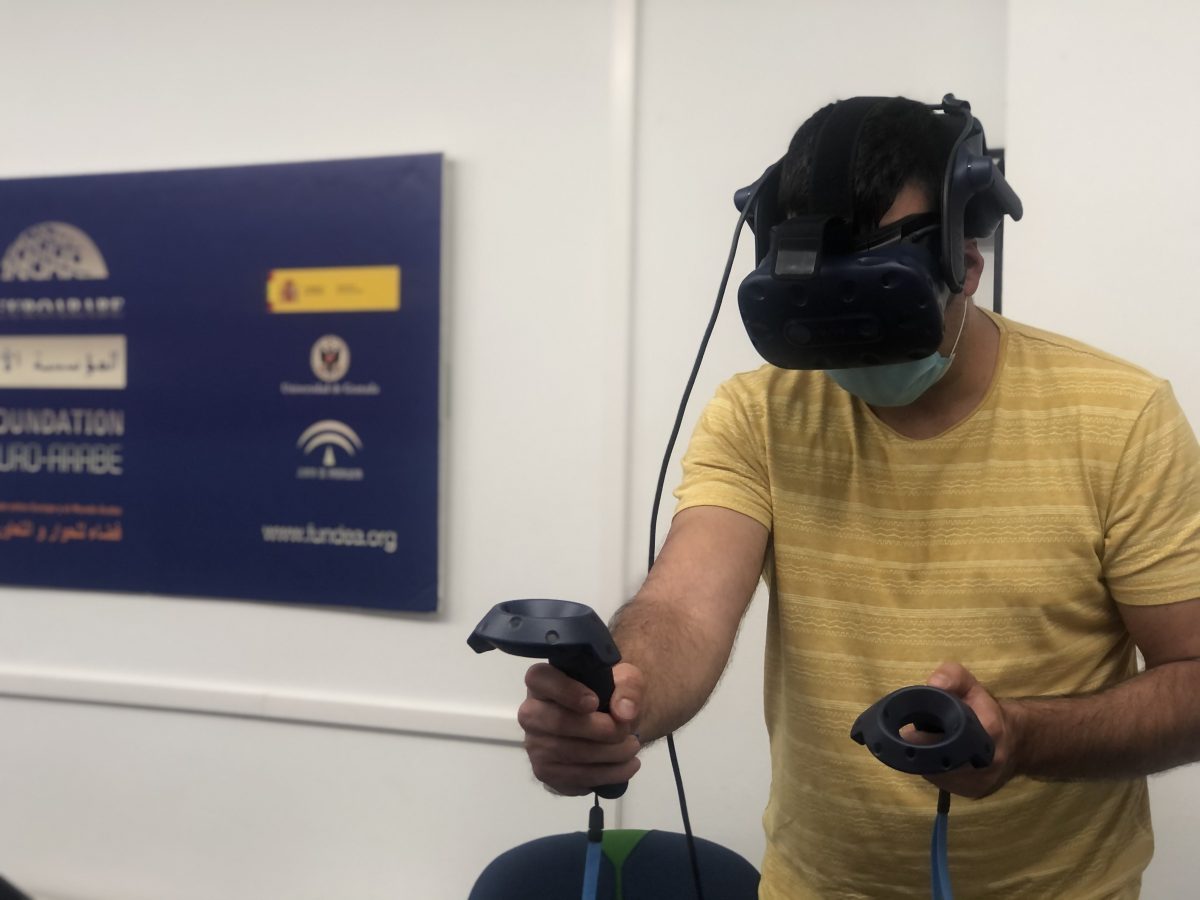
Virtual Reality: a new methodology for our trainings on Security and Justice

As part of the EU-Justice Programme funded project SAT-LAW (“Strategic Assessment for Law and Policie Cooperation”), the Euro-Arab Foundation has integrated an innovative methodology to deliver training courses practitioners, developed by our partner AGENFOR: the Virtual Reality (VR) Blended Solution.

The equipment and hardware technology for virtual reality acquired at FUNDEA allow to streamline and gain more value from the training processes related to security and justice. As a learning tool, virtual reality allows beneficiaries, such as LEAs, judiciary and private agencies in the fields of security and justice, to recreate scenarios through a virtual simulation in approaching threats and risks. It is a new opportunity for group collaboration, interactivity between participants and full immersive experiences in critical environment, where participants can study and analyse situations and find innovative solutions (Bellina, 2021).

The VR blended solution combines four training methods: immersive VR Training; 360° immersive learning environment; synchronic and a-synchronic online delivery and traditional face-to-face lessons.

For more information, see the Agenfor Technological Lab: https://www.agenformedia.com/technological-lab/

The Euro-Arab Foundation will  carry out its first virtual reality workshop on 17 September within the framework of the SAT-LAW project and will develop new workshops in the future.

____________
Bibliography:

Bellina, S. (2021) Training and rehabilitation: the continuing growth of virtual reality in security. Agenformedia.com Retrieved from: https://www.agenformedia.com/publication/training-and-rehabilitation-the-continuing-growth-of-virtual-reality-in-security/

Categories
EN Trace News

The TRACE electronic platform for European traditional children’s stories has been launched

The TRACE project (Traditional children’s stories for a common future) presents a digital platform that culminates all the work carried out throughout this project and that has been conceived as a showcase through which to show the richness and diversity of the European Union through traditional children’s stories.

This platform contains the resources of an innovative educational method: workshops exclusively designed to promote children critical thinking, explore and design innovative ways of learning about the cultures and traditions of other European countries.

The digital materials generated during the project are in open access in the thematic TRACE Portal available for use in classrooms and activities with children from 6 to 12 years old, for all teaching and library staff who want to make the European cultures and traditions known.

The electronic platform is divided into several sections that give access to the selected and translated stories, to the files to carry out the workshops, as well as guidelines and orientations for teachers and librarians. These documents have been produced in English and translated into the languages ​​of each of the partner countries (Croatia, Spain, Greece and Latvia). The goal is to pilot these materials in schools and libraries.

The story section is made up of several elements:

• Parallel text of the story in the original language and its translation into English

• Short story workshop with download (PDF)

• Children’s drawings created in workshops

• Metadata

• History translated into all partner languages and English (PDF)

• Electronic book in English language with all the stories used in the TRACE Project.

Tools such as TRACE’s allow progress towards a new type of education, which consists of providing students with a greater capacity for research, critical thinking and drawing conclusions, with the aim of stimulating the development of thinking and adoption of own ideas, the understanding of oneself and the society in which we live, and also of finding one’s own orientation in life and ethical values.

To guarantee the exploitation of these resources among professionals in the sector, several dissemination events were held in June in Croatia, Greece, Latvia and Spain, including the online course: “Working with multiculturalism and critical thinking from children’s stories” held last Tuesday June 22 by the Euro-Arab Foundation.

If you are interested in reproducing any of these workshops and accessing the files for teachers and parents in Spanish, please contact: documentacion@fundea.org  

Categories
EN Pave News

PAVE Interview Mini-series

To explain the project and its peculiarities, the PAVE project partners have recorded a series of four interview clips answering questions that reflect the development of the project. The PAVE project seeks to understand the role of community and the dynamics of radicalization and the role played by communities in building more resilience societies against violent extremism.

These short videos reveal how the project’s participatory and inter-regional approach and its focus on the community is effective to tackle the global issue of radicalization in order to strengthen the capacity of policy-makers and community leaders for an effective prevention strategy between the European Union and its neighborhood.

To see these videos, you can click on the links below:

To know more about the project, visit its website: https://pave-project.eu/

The videos can be viewed and downloaded by clicking here.

Categories
EN Retopea News

‘Docutubes’ workshop for religious peace and tolerance in Granada

The RETOPEA H2020 project has developed a workshop model for adolescents based on a collection of examples of how people in Europe and beyond, in many different historical periods, have thought about and experienced different religious beliefs and practices and found ways of living together.

During June and July, The RETOPEA team is carrying out, these workshops in educational centers in the province of Granada, Belgium, the United Kingdom, Germany, Estonia, Finland and North Macedonia.

The purpose of the workshop is to allow students to engage in creative ways with the subject of religious toleration and peace, both in historical and the contemporary settings through shorts ‘documentaries’ that will be recorded in different parts of the city.

The Euro-Arab Foundation together with partners from the University of Granada and The Open University (England) in collaboration wih Dar Al Anwar will carry out this workshop in Granada from July 8 to 10.An event hosted bythe Almirante’s Palace and the headquarters of the Euro-Arab Foundation in which young people will discover and record emblematic places of Granada: in its center and the Albayzin neighborhood. During three days, The RETOPEA team will accompany young people between 12 and 15 years old who came to our city from countries such as Morocco, Ghana, Sweden, France, Malaysia, among others, to convert their idea about ​​religious peace and tolerance into visual elements in a short visual communication. We call “Docutubes” the short films inspired by the RETOPEA clippings in a format similar to Vlogging on YouTube.

The RETOPEA collection includes more than 400 clippings which cover 12 themes that comes with a set of questions to encourage critical thinking about the issues it raises: ‘Gender and Sexuality’; ‘Migration, trade and travel’; ‘Propaganda, stereotyping and communication’; ‘Discrimination and being different’; ‘Ideas about toleration’; ‘Peace and conflict resolution’; Memory and Heritage’; ‘Law, police and public order’; ‘Places and buildings’; ‘Religious practice’;’ Clothing and dress’ and ‘Family life’.

Categories
EN Perceptions News

The Euro-Arab Foundation participates in the 18th IMISCOE CONFERENCE 2021

Researchers from “the Department of Projects & Research” of the Euro-Arab Foundation will participate in the IMISCOE Annual Conference ‘Crossing borders, connecting cultures’ (July 7-9).

Two panels ‘Migrants’ perceptions of the EU. Imaginaries, policies and symbolic management across Europe and beyond‘ will be dedicated to presenting the results of the PERCEPTIONS H2020 project on July 7, from 14:00 to 15:30, and from 15:45 to 17:15.  

These two panels will analyse  how migrants perceive migration to Europe , as well as the narratives of journalists and policy makers and how this (potentially) relates to each other. Perceptions on (migration to) Europe are structured by prevailing and each continuously reinforcing narratives that are spread through (social) media, by policy makers and personal networks. These perceptions vary along migration trajectories as they are part of social constructions that are repeatedly reinterpreted through a series of stories and highly impacted by information campaigns and migration management by policy makers.

José M. González Riera and Patricia Bueso Izquierdo will present some of the results of the research carried out by the Foundation in a paper  titled: Across the Strait: migrants’ narratives on Europe in Morocco and Spain.

Our research has studied the Moroccan context, which in the last three decades has become a key transit country, mainly for sub-Saharan nationals on their way to Europe. At the same time, it continues to be the origin of a sizeable amount of Moroccan citizens migrating to the EU. Additionally, Morocco is consolidating as a host country, mainly for sub-Saharans (Khrouz & Lanza, 2015), many of whom reside irregularly despite of the two regularisations that the country has recently implemented (Benjelloun, 2017). A question often raised is which visions of the final destination move so many people to undertake such a costly and often perilous journey. This paper aims at comprehending the ways in which the perceptions and narratives of Spain/Europe are framed amongst migrants in Morocco on transit to Spain/Europe as well as potential Moroccan migrants. Such views will be then contrasted with those of migrants who have already arrived to Spain. Based on the assumption that these imaginaries are affected by migrants’ experiences, we aim at analysing the evolution of this narrative plasticity, assessing the ways in which the migration itinerary interacts with the perceptions and narratives from the country of origin to the final destination. We will depict the evolution of various patterns of narrative itineraries in parallel to the migration journeys.

This paper is based on the empirical research findings stemming from the fieldwork conducted in Morocco and Spain. The key outcomes will be discussed in terms of a better management of the migration flows and the development of migratory policy recommendations.

More information:


Categories
EN Hope News

European survey and research on deradicalization and disengagement

Creating a European Learning Hub on Radicalisation

The HOPE project is developing a network for continuous training and knowledge sharing in the Balkan, Southern and Eastern European countries.

This network aims to intervene in radicalisation prevention and disengagement and improve the transition between the prison and probation system and the community, for those at risk of radicalisation or who have already been radicalised.

Training and research organisations, academics, prison, and probation administrations make up the HOPE project network.

European Survey

As part of HOPE’s activities, we are carrying out a European survey for professionals engaged in deradicalization and disengagement in order to evaluate their needs within the prison and probation context and to identify the current state of prevention strategies and efforts to promote deradicalisation and disengagement.

Take the survey: https://psicsocialugr.qualtrics.com/jfe/form/SV_bq0v7vstyXl1A2i
From July 1 to 20
Available in different languages (Bulgarian, English, French, Italian, Portuguese, Serbian, Slovenian, and Spanish).
The survey is completely online, take no longer than 20 minutes, and it is completely anonymous.

Interviews

To deepen this research, the Euro-Arab Foundation will carry out throughout the month of July interviews with professionals who work on (de)radicalization in prisons in order to identify the problems they encounter.