Categories
EN Bigosint EN Sat-Law EN Unchained News

Event on “Judicial and Police Cooperation: Best Practices”

The Euro-Arab Foundation participates to the Joint Event “Judicial and Police Cooperation: Best Practices” organized by Agenfor International Foundation in collaboration with the Italian Ministry of Justice, which will see the presence of several European partners that work with the two organisers in the implementation of European projects on judicial and police cooperation.

The event will take place on 22/23 September 2021 in San Servolo Venice island.

Conferences and Roundtable

Public conferences on “New investigative models for THB in the Framework of Public-Private Cooperation (Fairness, Unchained and Big Osint)” and “Navigating the Complexities of Judicial Cooperation Instruments (Sat-Law, Treio, Pre-triad and pre rights)”

Round table on: “Threats from east and south: oil & gas smuggling as serious polycrimes”

Three European Projects in which the Euro-Arab Foundation participates are involved in this event:

UNCHAINED – Untangling the Trafficking Chain. Disrupting the Financial Business Model of Traffickin Technological partners
BIG OSINT (COUNTERING THB THROUGH BIG DATA & OSINT ANALYSIS)
SAT-LAW
– Strategic Assessment for Law and Police Cooperation

The event will be enriched by the presence of technological companies with cutting-edge expertise in the security field. They will provide both a crucial technical perspective to the topics treated in the conferences and roundtables, and will give the participants the chance to learn about the latest technological developments in the sector.

To participate online to the event, register here: https://us02web.zoom.us/meeting/register/tZIkd-2trDwrG9D6vMTE19yguMW8l4pKJ-OC

Categories
Miict News

The MIICT project winner of the XVII edition of the Andalusia Migration Awards

MIICT project on migration and information technologies wins the Andalusian Migration Award from the Council of the Presidency of the Junta de Andalucía.

The winner of the Social Awareness and / or Interculturality Programs category of the Andalusian Migration Awards Network is the Inmerse platform, created by the Euro-Arab Foundation. The jury highlighted that its objective is to promote immigrants integration of through information, dialogue or encounters through communication and information technologies. The project meets the conditions to bring public services closer to immigrants, the result of a very enriching process of co-creation and collaboration.

The IMMERSE platform: A bi-lingual web-based platform that consists of a database and intelligent analytics system that captures the specific socio-cultural, economic and legal contexts of migrants that is shared with public authorities. The platform enable effect management of migrant’s’ integration into the EU labour market by providing means to better understand individual contexts, allowing individuals to seek opportunities for skills development and employment and enabling public authorities to automatically match their access to services such as education, welfare, employment and healthcare in host countries.

This platform, which is being carried out as a pilot test in three countries, Spain, Cyprus and Italy, has been tested with the participation of the users themselves and also NGOs. In Spain, the Euro-Arab Foundation has ended this testing phase with very good results. Cyprus and Italy will conclude it shortly.

Categories
EN Sat-Law News

SAT-LAW Virtual Reality Workshop on the future challenges of judicial cooperation in criminal matters

The SAT LAW Project (Strategic Assessment for Law and Police Cooperation) and the Andalusia Initiative for the Future of Europe organize a training event that will take place at the Euro-Arab Foundation next Friday, September 17.

A Round Table will be organized from 9:30 to 11:30 to discuss the great challenges that faces judicial cooperation in criminal matters in the European Union. This event will feature an intervention by the Hon. Mrs. Rosa A. Morán Martínez (Supreme Court Prosecutor, Head, International Cooperation Unit), followed by a debate where judges, prosecutors, lawyers, judicial police and academics will participate.

A Virtual Training on the European Investigation Order in Criminal Matters (EIO) will also be held at our headquarters, aimed at professionals who use this instrument of judicial cooperation in their work. Both Spanish professionals present at the Euro-Arab Foundation and their Italian counterparts will participate in this exercise, who will solve practical cases related to the EIO in real time from their country.

Categories
EN Sat-Law News

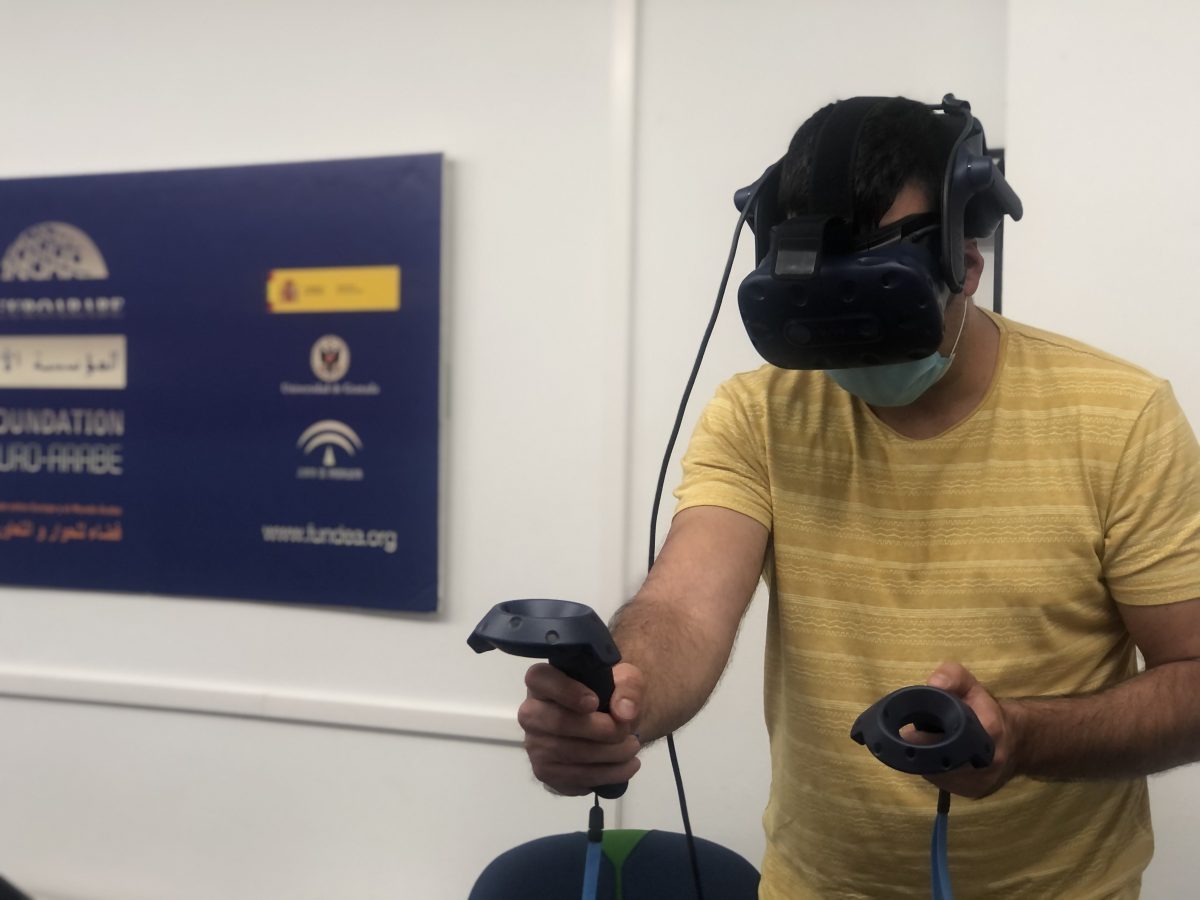
Virtual Reality: a new methodology for our trainings on Security and Justice

As part of the EU-Justice Programme funded project SAT-LAW (“Strategic Assessment for Law and Policie Cooperation”), the Euro-Arab Foundation has integrated an innovative methodology to deliver training courses practitioners, developed by our partner AGENFOR: the Virtual Reality (VR) Blended Solution.

The equipment and hardware technology for virtual reality acquired at FUNDEA allow to streamline and gain more value from the training processes related to security and justice. As a learning tool, virtual reality allows beneficiaries, such as LEAs, judiciary and private agencies in the fields of security and justice, to recreate scenarios through a virtual simulation in approaching threats and risks. It is a new opportunity for group collaboration, interactivity between participants and full immersive experiences in critical environment, where participants can study and analyse situations and find innovative solutions (Bellina, 2021).

The VR blended solution combines four training methods: immersive VR Training; 360° immersive learning environment; synchronic and a-synchronic online delivery and traditional face-to-face lessons.

For more information, see the Agenfor Technological Lab: https://www.agenformedia.com/technological-lab/

The Euro-Arab Foundation will  carry out its first virtual reality workshop on 17 September within the framework of the SAT-LAW project and will develop new workshops in the future.

____________
Bibliography:

Bellina, S. (2021) Training and rehabilitation: the continuing growth of virtual reality in security. Agenformedia.com Retrieved from: https://www.agenformedia.com/publication/training-and-rehabilitation-the-continuing-growth-of-virtual-reality-in-security/

Categories
News

World Day Against Trafficking in Persons

The UNCHAINED project, in which the Euro-Arab Foundation participate, celebrates the World Day Against Trafficking in Persons joining the Blue Heart United Nations campaign coordinated by UNODC. This year’s theme highlights the importance of listening to and learning from survivors of human trafficking. The UNCHAINED project partners recognize the importance of involving victims and survivors in anti-trafficking action.

One of the particularities of this project, in which the Euro-Arab Foundation participate, is the focus on the key topic of financial flows into and out of these types of high profit activities, which allows to expose and prevent the range of actors and decision makers involved and their modus operandi. The follow-the-money approach is a necessary element to counteract THB and give survivors back their rights and needs.

The Euro-Arab Foundation for Higher Studies also joins this commemoration giving voice to the survivors  of trafficking and raising awareness about this serious violation of human rights that deprives people of their freedom by exploitaiting them under the most varied forms such as, sexual or labour exploitation, being forced to marriage or to commit a crime or, organ transplants among others.

“World Day Against Trafficking in Persons: On Invisibilities and Borders” by Patricia Bueso Izquierdo (in Spanish) for the blog of the Euro-Arab Foundation

Here an extract of the text translated into English:

“The demand for exploitation is increasing, sponsored by crimes committed on the Internet that favor the financial opacity of the profits obtained in crime, the COVID-19 pandemic contributing to the increase in the numbers and the invisibility of the people who are the object of about.

We would like to highlight in this regard that even today in 2021 new legislative measures are still necessary to jointly address trafficking in human beings, in order to be able to identify and detect potential victims early among the most vulnerable groups such as minors and / or people with functional mobility and with the aim of dismantling the business model of traffickers to which the UNCHAINED project contributes, also highlighting that the training of the agents involved and international cooperation with third countries are other necessary pillars to eradicate and combat this crime.

Let us take advantage not only of this World Day, but every day of the year, to create spaces for opinion and public debate that make this reality known by putting names and surnames to all the people who are being exploited daily next to us. Let us know to detect and not to discriminate, let us walk alongside these women and girls who like us want to be free and enjoy safety”

Categories
EN Trace News

The TRACE electronic platform for European traditional children’s stories has been launched

The TRACE project (Traditional children’s stories for a common future) presents a digital platform that culminates all the work carried out throughout this project and that has been conceived as a showcase through which to show the richness and diversity of the European Union through traditional children’s stories.

This platform contains the resources of an innovative educational method: workshops exclusively designed to promote children critical thinking, explore and design innovative ways of learning about the cultures and traditions of other European countries.

The digital materials generated during the project are in open access in the thematic TRACE Portal available for use in classrooms and activities with children from 6 to 12 years old, for all teaching and library staff who want to make the European cultures and traditions known.

The electronic platform is divided into several sections that give access to the selected and translated stories, to the files to carry out the workshops, as well as guidelines and orientations for teachers and librarians. These documents have been produced in English and translated into the languages ​​of each of the partner countries (Croatia, Spain, Greece and Latvia). The goal is to pilot these materials in schools and libraries.

The story section is made up of several elements:

• Parallel text of the story in the original language and its translation into English

• Short story workshop with download (PDF)

• Children’s drawings created in workshops

• Metadata

• History translated into all partner languages and English (PDF)

• Electronic book in English language with all the stories used in the TRACE Project.

Tools such as TRACE’s allow progress towards a new type of education, which consists of providing students with a greater capacity for research, critical thinking and drawing conclusions, with the aim of stimulating the development of thinking and adoption of own ideas, the understanding of oneself and the society in which we live, and also of finding one’s own orientation in life and ethical values.

To guarantee the exploitation of these resources among professionals in the sector, several dissemination events were held in June in Croatia, Greece, Latvia and Spain, including the online course: “Working with multiculturalism and critical thinking from children’s stories” held last Tuesday June 22 by the Euro-Arab Foundation.

If you are interested in reproducing any of these workshops and accessing the files for teachers and parents in Spanish, please contact: documentacion@fundea.org  

Categories
EN Pave News

PAVE Interview Mini-series

To explain the project and its peculiarities, the PAVE project partners have recorded a series of four interview clips answering questions that reflect the development of the project. The PAVE project seeks to understand the role of community and the dynamics of radicalization and the role played by communities in building more resilience societies against violent extremism.

These short videos reveal how the project’s participatory and inter-regional approach and its focus on the community is effective to tackle the global issue of radicalization in order to strengthen the capacity of policy-makers and community leaders for an effective prevention strategy between the European Union and its neighborhood.

To see these videos, you can click on the links below:

To know more about the project, visit its website: https://pave-project.eu/

The videos can be viewed and downloaded by clicking here.

Categories
News

TRACE Third Transnational Meeting in Granada

The Erasmus + TRACE project on ‘Traditional children’s stories for a common future’ developed by the Euro-Arab Foundation together with European partners from Croatia, Greece and Latvia, concludes its three-year work in Granada. This third transnational meeting of the project has taken place on July 15 and 16, 2021 at the headquarters of the Euro-Arab Foundation.

The executive secretary of the Euro-Arab, Inmaculada Marrero Rocha, congratulated the different partners who arrived from Croatia, Greece and Latvia, who together with the Euro-Arab Foundation as a Spanish partner, make up the consortium of this project financed by the Erasmus + program.

During these two days, TRACE partners have analysed and evaluated the programs and activities that they have been developing over the past two years, applying innovative educational methods. The results achieved have been evaluated and the future exploitation plan for the resources available on the digital platform designed. In it, the selected and translated stories are available in several languages, to the worksheets to carry out the workshops, as well as guidelines and orientations for teachers and librarians.

Access to the Platform

Categories
EN Retopea News

‘Docutubes’ workshop for religious peace and tolerance in Granada

The RETOPEA H2020 project has developed a workshop model for adolescents based on a collection of examples of how people in Europe and beyond, in many different historical periods, have thought about and experienced different religious beliefs and practices and found ways of living together.

During June and July, The RETOPEA team is carrying out, these workshops in educational centers in the province of Granada, Belgium, the United Kingdom, Germany, Estonia, Finland and North Macedonia.

The purpose of the workshop is to allow students to engage in creative ways with the subject of religious toleration and peace, both in historical and the contemporary settings through shorts ‘documentaries’ that will be recorded in different parts of the city.

The Euro-Arab Foundation together with partners from the University of Granada and The Open University (England) in collaboration wih Dar Al Anwar will carry out this workshop in Granada from July 8 to 10.An event hosted bythe Almirante’s Palace and the headquarters of the Euro-Arab Foundation in which young people will discover and record emblematic places of Granada: in its center and the Albayzin neighborhood. During three days, The RETOPEA team will accompany young people between 12 and 15 years old who came to our city from countries such as Morocco, Ghana, Sweden, France, Malaysia, among others, to convert their idea about ​​religious peace and tolerance into visual elements in a short visual communication. We call “Docutubes” the short films inspired by the RETOPEA clippings in a format similar to Vlogging on YouTube.

The RETOPEA collection includes more than 400 clippings which cover 12 themes that comes with a set of questions to encourage critical thinking about the issues it raises: ‘Gender and Sexuality’; ‘Migration, trade and travel’; ‘Propaganda, stereotyping and communication’; ‘Discrimination and being different’; ‘Ideas about toleration’; ‘Peace and conflict resolution’; Memory and Heritage’; ‘Law, police and public order’; ‘Places and buildings’; ‘Religious practice’;’ Clothing and dress’ and ‘Family life’.

Categories
EN Perceptions News

The Euro-Arab Foundation participates in the 18th IMISCOE CONFERENCE 2021

Researchers from “the Department of Projects & Research” of the Euro-Arab Foundation will participate in the IMISCOE Annual Conference ‘Crossing borders, connecting cultures’ (July 7-9).

Two panels ‘Migrants’ perceptions of the EU. Imaginaries, policies and symbolic management across Europe and beyond‘ will be dedicated to presenting the results of the PERCEPTIONS H2020 project on July 7, from 14:00 to 15:30, and from 15:45 to 17:15.  

These two panels will analyse  how migrants perceive migration to Europe , as well as the narratives of journalists and policy makers and how this (potentially) relates to each other. Perceptions on (migration to) Europe are structured by prevailing and each continuously reinforcing narratives that are spread through (social) media, by policy makers and personal networks. These perceptions vary along migration trajectories as they are part of social constructions that are repeatedly reinterpreted through a series of stories and highly impacted by information campaigns and migration management by policy makers.

José M. González Riera and Patricia Bueso Izquierdo will present some of the results of the research carried out by the Foundation in a paper  titled: Across the Strait: migrants’ narratives on Europe in Morocco and Spain.

Our research has studied the Moroccan context, which in the last three decades has become a key transit country, mainly for sub-Saharan nationals on their way to Europe. At the same time, it continues to be the origin of a sizeable amount of Moroccan citizens migrating to the EU. Additionally, Morocco is consolidating as a host country, mainly for sub-Saharans (Khrouz & Lanza, 2015), many of whom reside irregularly despite of the two regularisations that the country has recently implemented (Benjelloun, 2017). A question often raised is which visions of the final destination move so many people to undertake such a costly and often perilous journey. This paper aims at comprehending the ways in which the perceptions and narratives of Spain/Europe are framed amongst migrants in Morocco on transit to Spain/Europe as well as potential Moroccan migrants. Such views will be then contrasted with those of migrants who have already arrived to Spain. Based on the assumption that these imaginaries are affected by migrants’ experiences, we aim at analysing the evolution of this narrative plasticity, assessing the ways in which the migration itinerary interacts with the perceptions and narratives from the country of origin to the final destination. We will depict the evolution of various patterns of narrative itineraries in parallel to the migration journeys.

This paper is based on the empirical research findings stemming from the fieldwork conducted in Morocco and Spain. The key outcomes will be discussed in terms of a better management of the migration flows and the development of migratory policy recommendations.

More information: