


The Euro-Arab Foundation, a key institution for the protection of places of worship
The document Building Safer Public Spaces: Key Learnings and Recommendations from the 2026 European Conference on Security in Public Spaces and Protection sets out the main conclusions of a conference held on 12 June 2026 in Nicosia, Cyprus. The event brought together more than 180 participants from 60 organisations based in 14 European countries, joined by representatives from Brazil, Japan and China.
In the words of Zenonas Tziarras, Professor in the Department of Turkish and Middle Eastern Studies at the University of Cyprus, “the imperative is not to imagine a world without risk, as none has ever existed, but to cultivate the capacity to live with uncertainty without allowing it to erode trust, deepen social fragmentation or undermine democratic life. All of this requires preparedness, effective institutions and robust security policies.”
“the imperative is not to imagine a world without risk, as none has ever existed, but to cultivate the capacity to live with uncertainty without allowing it to erode trust, deepen social fragmentation or undermine democratic life. All of this requires preparedness, effective institutions and robust security policies.” Zenonas Tziarras
Among the cases examined in the document was the attack that took place in the centre of Modena, Italy, on 16 May. Several organisations had received advance warnings, which highlights the absence of official channels for sharing such information, channels that could have triggered a coordinated intervention.
As a result of the various panel discussions, six actions were recommended:
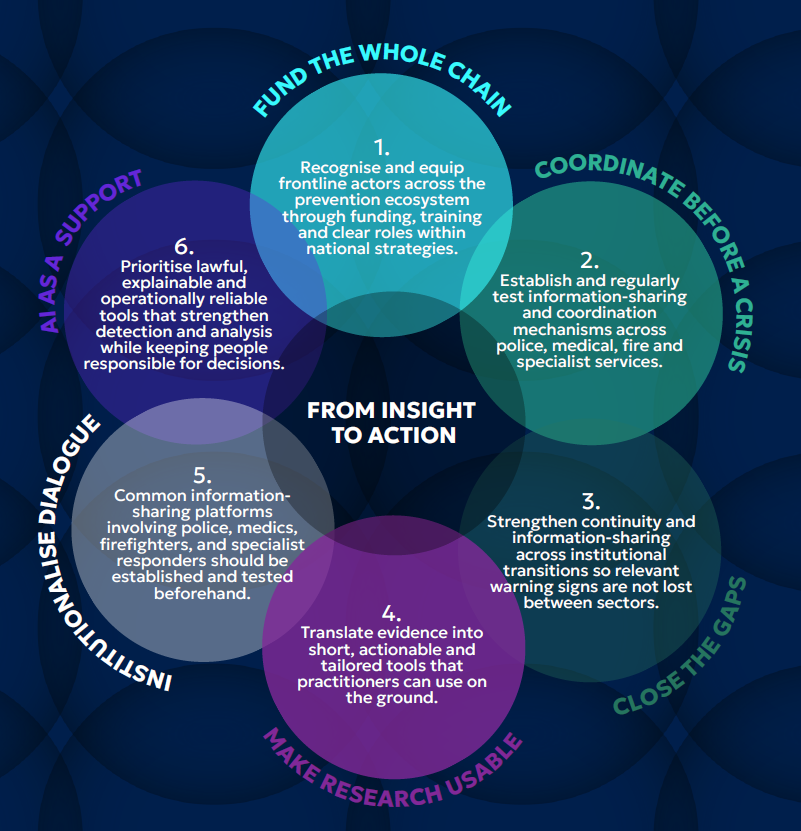
- Establish the full chain for training, detecting and responding to risk situations, with frontline personnel and clearly defined roles within national strategies.
- Ensure crisis coordination through shared-information exercises and coordination mechanisms across law enforcement, medical personnel, and rescue and emergency services.
- Close existing gaps by strengthening the continuity and sharing of information when risk warnings are issued, in order to prevent loss of information between parties.
- Design practical, evidence-based tools for professionals working in the field.
- Institutionalise dialogue through platforms that connect law enforcement, medical professionals and first-response teams.
- Prioritise reliable, accessible and operational tools for risk detection and analysis, while preserving human responsibility in decision-making.
The convergence of these six pillars enables these findings to be translated into action in support of cooperation, preparedness and resilience across the entire security ecosystem.


