Categories
ECLIPSE EN Projects

ECLIPSE: A Collaborative Project to Combat Hate Speech and Disinformation

On September 23rd and 24th, the Euro-Arab Foundation participated in the launch of a new project, ECLIPSE (an acronym for “Preventing and Combating onLine and offline hate speech and dIsinformation through multidisciPlinary innovation, education, and awareneSs in Europe”). This initiative is funded by the European Commission through its HORIZON Innovation Actions program.

The Italian city of Trento hosted the meeting, bringing together the consortium partners, including the Euro-Arab Foundation, the Andalusian Center for Studies, the City Council of Murcia, the University of Trento, Northumbria University of Newcastle, the Free University of Brussels, Sabancı University of Turkey, the Governorate of Ankara, the CSI Center for Social Innovation, the Serbian Institute for AI Research and Development, the German Institute SYNYO, the University of Applied Sciences for Public Administration and Legal Affairs in Bavaria, CESIE Third Sector Entity, Stop Hate UK, YEU Youth for Exchange and Understanding, the International Centre for Migration Policy Development of Austria, and Creative Workers of Belgium. The consortium is coordinated by the Bruno Kessler Foundation.


A Multidisciplinary Approach to a Global Problem

The ECLIPSE project aims not only to combat hate speech and disinformation in Europe but also to strengthen social cohesion, empower citizens, and provide law enforcement and public authorities with effective tools to build a more informed, critical, and resilient society. It will combine advanced technologies with knowledge from fields such as social sciences, criminology, law, and behavioral psychology. Through this synergy, the project will develop tools for the automated analysis of harmful content and the creation of effective, culturally sensitive counter-narratives that respect fundamental rights. At the same time, ECLIPSE promotes the active participation of target groups through innovative training methodologies, such as digital storytelling, gamification, and augmented/extended reality (AR/XR).

The Euro-Arab Foundation will play a key role in the project as the leader of the work package focused on education, training, and public policy recommendations. From this position, it will coordinate the development of pedagogical tools, innovative methodologies, and curricula tailored to different social actors: law enforcement, teachers, social professionals, and civil organizations.


European and Global Impact of the Project

One of the project’s main pillars is the creation of validated tools, methodologies, and training curricula for various social actors, from security forces to educators and civil organizations. ECLIPSE also aims to harmonize European approaches to data collection and the implementation of countermeasures, always ensuring respect for freedom of expression and privacy.

Furthermore, the Euro-Arab Foundation will be responsible for strengthening the capacity of law enforcement agencies (LEAs), civil society organizations (CSOs), and international organizations to confront hate speech and disinformation. To do this, it will develop tailored training, gamified workshops, and continuous evaluation processes. Its tasks include:

  • Creating educational and learning materials through a one-day online workshop with 20 participants, including LEAs, CSOs, and experts, to co-create materials on media literacy, human rights, and best practices against hate speech and disinformation.
  • Conducting two in-person gamified workshops in Brussels for LEAs, CSOs, and international organizations, using AR/XR, gamification, and digital storytelling to enhance capabilities.
  • Continuously evaluating the effectiveness of the training materials and sessions.
  • Drafting evidence-based policy briefs to support decision-making and foster multi-agency cooperation and sustainability.

The Foundation will lead the development of these public policy reports, which will include practical recommendations for national and European policymakers, with the goal of promoting a coherent and effective approach to hate speech and disinformation.

The results of ECLIPSE will be deployed through pilot projects in Belgium, Germany, Austria, Italy, the United Kingdom, Spain, and Turkey, as a preliminary step towards broader adoption across Europe and potentially on a global level.

Categories
EUKH EN News RADICALIZACION EN

The Euro-Arab Foundation Contributes to the European Research on Global and Geopolitics of Radicalisation

As part of its work at the European Knowledge Hub on Prevention of Radicalisation, the Euro-Arab Foundation is a member of the Research Secretariat for Thematic Panel 7, ‘Global and geopolitical factors and unwanted foreign influences’. Daniel F. Pérez García, a researcher and European projects manager, as well as a trainer on the prevention of radicalisation and violent extremism, is responsible for this secretariat task for a panel that examines how geopolitical factors and global dynamics drive radicalisation and extremism within the EU, particularly when unwanted foreign influences are involved.

The work of this panel, comprised of a group of experts from the academic, security, and political fields, focuses on offering evidence-based recommendations to member states to strengthen their proactive and reactive capacity against the external promotion of radicalisation. Thus, the panel analyses the influence of international and geopolitical events on extremist multi-ideological mobilisation in Europe, as well as influence and undesirable interference campaigns to strengthen radical groups in the EU.

The panel promotes dialogue among researchers, policymakers, and professionals to design strategies adapted to these emerging challenges, improve resilience, identify key players and their tactics, and evaluate the effectiveness of existing prevention instruments. It also facilitates cooperation with allied countries, such as those in the Mediterranean or the Western Balkans, and contributes to the EU’s Agenda for the Prevention of Terrorism and Violent Extremism.

“Preparing the Ground: Global Impact and Foreign Interference in the Prevention and Countering of Violent Extremism (P/CVE)” is the title of the first meeting that brought together members of this panel, and the final results can be consulted on this website.

Categories
EUKH EN News

The Foundation’s role in understanding the links between mental health and lone actors in the EU Knowledge Hub

The Euro-Arab Foundation actively participates in the analysis of mental health in radicalisation processes, investigating how these factors can lead a person to become a “lone actor.” While this has been a subject of study for some time, the EU Knowledge Hub decided to create a thematic panel of experts dedicated exclusively to deepening the understanding of individuals who act alone in European Union member states, their connections with other online actors and groups, and their relationship with mental health problems.

The Research Secretariat of this panel rests exclusively with a Euro-Arab team made up of researchers: Paula Cano Cruz, José Luis Salido Medina, and Soukaina Belkat. The main objective is to understand how to identify these individuals to prevent violent acts, clarifying the concept of “lone actors” to strengthen cooperation at the EU level. The work is based on existing research and addresses how lone actors become radicalised, the role of mental health in radicalisation, the connection between these individuals and the online world (including indicators for their identification), and the best practices for cooperation and prevention.

The Research Secretariat of Thematic Panel 5 rests entirely with this team from the Euro-Arab Foundation.

Paula Cano Cruz is a researcher at the Euro-Arab Foundation in the field of hate speech, ideologies, and extremist movements. Sukaina Belkat is also a researcher at the Foundation and has worked as a mediator. For his part, José Luis Salido, a researcher at the Foundation and project manager, specialises in radicalisation and extremist movements.

You can find more information on the European Knowledge Centre for the Prevention of Radicalisation page: Thematic Panel 5 – Lone Actors and Mental Health Issues.

Categories
News Projects VANGUARD

World Day Against Trafficking in Persons

Human trafficking involves the recruitment, transportation, transfer, harbouring or receipt of persons by means of threats, use of force or other forms of coercion, for the purpose of exploitation, which may be sexual, labour-related, or for the removal of organs, among others.

The United Nations General Assembly designated 30 July as World Day Against Trafficking in Persons in 2013, with the aim of mobilising resources and efforts to combat this crime and support victims.

The Euro-Arab Foundation is involved in projects funded by the European Commission, such as VANGUARD, which aims to break the chain of human trafficking from a human rights perspective and put survivors at the centre of policies.

Categories
EUKH EN News

The Euro-Arab Foundation, Member of the Research Secretariat on Ideologies and Conspiracy Narratives of the EU Knowledge Hub

The EU Knowledge Hub on Prevention of Radicalisation, a European Commission knowledge center, decided in June 2024 to create seven thematic panels composed of experts from research, academia, security, and politics who deal with extremism and radicalisation. These panels began operating in February 2025, collaborating to exchange ideas, share experiences, and develop concrete recommendations for EU member states.

One of these panels is Thematic Panel 1 on Ideologies and Conspiracy Narratives, which is co-led by two experts and focuses on understanding extremist ideologies, including new hybrid or fragmented ones, and the role of conspiracy theories in the radicalisation process. The Euro-Arab Foundation for Higher Studies is part of the Research Secretariat of this panel through Isabel Pérez Pérez, Communication Manager of the Foundation’s Department of Research and International Projects. Pérez uses her academic and professional experience in journalism to identify and dismantle extreme, conspiratorial, or manipulative ideologies, collaborating in institutional and academic forums to promote fairer, more critical, and less vulnerable narratives against hate and propaganda.

Addressing Radicalization and Conspiracy Narratives

Radicalisation is a complex process where individuals or groups adopt radical ideologies that justify violent or terrorist acts to achieve political goals or expand their ideology. In the EU, radicalisation has recently taken on connotations of hybrid, fragmented, or mixed ideologies, posing greater challenges to understanding their dynamics, origins, and evolution.

The Thematic Panel on Ideologies and Conspiracy Narratives analyzes how radical narratives spread digitally, their influence on recruiting and mobilising individuals, especially vulnerable youth, and examines threats such as jihadism, right-wing extremism, leftist tendencies, and viral conspiracy theories. Its key objectives include building an inventory of radical and conspiratorial narratives, identifying vulnerability factors, proposing effective preventive strategies, and defining legal and public policy frameworks to counteract these ideologies within EU member states.

So far, the Panel has held two meetings in May and July 2025, addressing topics such as how and why minors and youth are attracted to extremist ideologies, and the nexus between organized crime and extremism (how ideologies and conspiracy theories fuel the symbiotic relationship between crime and extremism).

The results of these meetings are publicly available on the thematic panel’s website.

https://home-affairs.ec.europa.eu/networks/eu-knowledge-hub-prevention-radicalisation/thematic-panels/thematic-panel-1-ideologies-and-conspiracy-narratives_en

Categories
ERAMUS KA ADULT en News Projects

The E+ Program organises a mobility workshop on project writing and management

The deadline to submit applications and participate in the E+ Program mobility How to write a European project? which will take place from August 2 to 12 in Amblar-Don, Italy, is now open. This stay will be hosted by Ines- Itinerari in Natura per un’ Educazione Sostenible and its main objective is to facilitate the exchange of knowledge and experiences on writing and managing European projects, focusing mainly on the Erasmus+ program.

Participants will not only be able to strengthen their own skills, but will also act as trainers, sharing knowledge, methodologies and good practices in the preparation of European proposals. This bidirectional teaching-learning interaction will strengthen institutional capacities, foster international collaboration and generate an impact at both individual and collective levels, by promoting a culture of active participation in initiatives financed by the European Union. The activity is co-financed by the Erasmus+ program and covers accommodation, food, insurance, travel and educational activity expenses.

To participate, send an email to: edesolidaridad[at]gmail.com

Categories
data quality en News Projects

DATA EQUALITY Consortium to Forge Common EU Methodology

The final workshop of the European project DATA EQUALITY will take place on July 9th in Rimini, Italy. The Euro-Arab Foundation is part of this project, which aims to prevent and combat intersectional data discrimination. This workshop brings together law enforcement agencies, judicial professionals, civil society organizations, and researchers to discuss the main conclusions from four thematic Working Groups. These groups focused on data collection and management, data analysis, data exchange, and bias and ethical issues in the use of data for Artificial Intelligence (AI) and Open Source Intelligence (OSINT) tools.

Throughout the project, participants from across Europe have explored common challenges and shared best practices. Through three transnational workshops and four specific working groups, they have identified key elements that should shape a Shared European Methodology on Equality Data. This new methodology aims to promote the ethical, secure, and inclusive use of data related to discrimination.

About DATA EQUALITY

DATA EQUALITY is a project funded by the European Commission through the Citizens, Equality, Rights and Values (CERV) Programme. The consortium, comprising nine members and coordinated by the Corte di Appello di Venezia, includes the Euro-Arab Foundation and the City Council of Murcia, along with other entities from various European countries. Launched in September 2024 and scheduled to conclude in May 2026, the project has three main objectives:

  • Improve the capacities of public authorities to effectively investigate, prosecute, and adequately sentence discrimination incidents.
  • Enhance cooperation and information exchange among public authorities (particularly district courts and municipal and regional administrations), as well as between public authorities and other stakeholders, such as civil society organizations and community representatives, to improve responses to discrimination, racism, xenophobia, and other forms of intolerance.
  • Improve the discrimination recording and data collection system, enhance the methodological approach, and foster inter-institutional cooperation in data collection.
Categories
IN2PREV-en News Projects

Granada Hosts Final IN2PREV Training Seminar

From June 24th to 26th, the Euro-Arab Foundation, a member of the consortium for the European IN2PREV project aimed at preventing radicalization through the successful inclusion of refugees, organized the project’s final training seminar. Titled Training of Trainers: Mentorship Program and Vulnerability Assessment, the activity brought together over 40 participants, including consortium partners and frontline professionals from Law Enforcement Agencies and non-governmental organizations across several European countries. The objective was to enhance their competencies in law enforcement and community cooperation to prevent radicalization by ensuring the inclusion of refugees.

To achieve this, the training developed the professionals’ capacity to transmit the knowledge acquired in previous IN2PREV trainings held in Poland and Slovakia. It also strengthened their understanding and use of the project’s products and fostered collaboration and the exchange of best practices between law enforcement agencies and non-governmental organizations.

IN2PREV Final Conference

The IN2PREV project is a European initiative that began in September 2022. The Euro-Arab Foundation participates as a member, alongside partners from Poland, Portugal, Romania, the Republic of Moldova, Slovakia, and Bosnia and Herzegovina.

The project’s goal is to facilitate the integration of refugees and asylum seekers and prevent their radicalization through the early identification of vulnerability risk factors. The successful inclusion of refugees as a means to prevent radicalization is a topic that, despite its recognized importance and growing concern, has not received adequate attention or action and is often addressed through highly securitized approaches.

After three years of research and training, the final IN2PREV project conference will take place on October 1st, 2025, in the Portuguese city of Porto. The event will serve as a platform to present the project’s final results to key organizations and representatives of the European Commission.

Categories
News Projects VANGUARD

Vanguard Project Shares Groundbreaking Anti-Trafficking Research at KU Leuven Workshop

On 16the June, researchers from the Vanguard project convened a hybrid workshop at KU Leuven University presenting the latest findings from their academic research on the prestigious Horizon Europe anti-trafficking initiative.

The workshop featured a presentation by Karen Hough from the Euro-Arab Foundation and Teresa Forlitti from Hart and Stand in the United States about their collaborative paper, “Creating sustainable models for the inclusion of lived experience experts in anti-trafficking preventative measures and policy making: insights from the Vanguard project”.

Attended by a diverse group of experts, including representatives from the European Commission, academia, and NGOs, the workshop fostered a highly productive and formative discussion. The research results were very well received, highlighting the project’s impact in the fight against human trafficking.

The Vanguard project, a European-financed initiative, is dedicated to strengthening the combat against human trafficking (THB). It achieves this by providing an improved intelligence picture, delivering an advanced and trustworthy suite of tools, and implementing innovative training activities.

Further workshops are planned in the coming months to continue sharing the project’s vital research and foster ongoing collaboration.

Categories
EN PARTES News PARTES-COM EN Projects

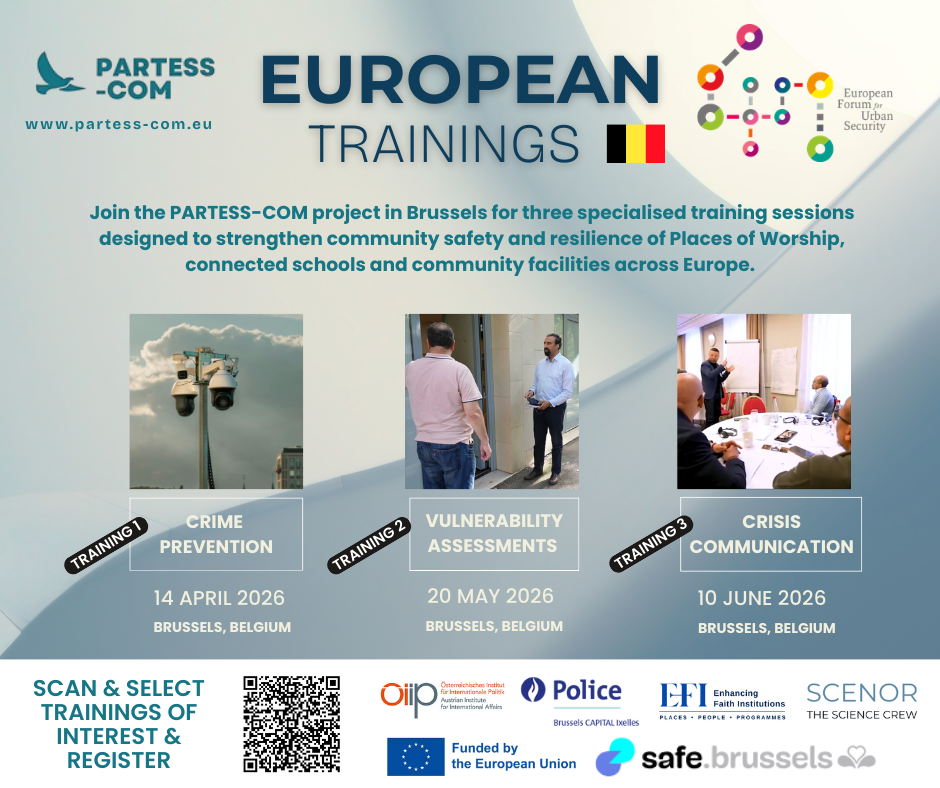
PARTES Project Concludes, Evolves into PARTESS-COM

On June 16, the PARTES project culminated in its final conference in Vienna, gathering researchers, faith-community representatives, and security experts. Over its two-year duration, the project focused on protecting places of worship. It was made possible by financial support from the European Commission’s Internal Security Fund (ISF) and saw fifteen partners from ten European countries collaborate on this vital initiative.

The European Commission’s DG Home’s representative underscored the crucial role of Union Actions projects, like PARTES, in tackling transnational issues affecting the entire EU. At its core, PARTES aimed to bolster the protection of places of worship by fostering a deeper understanding of violent extremism and its potential impact. Its six key objectives included mapping threats, assessing vulnerabilities, and facilitating the exchange of best practices among diverse religious communities.

A critical aspect addressed was online threats, with a presentation by SCENOR detailing how extremist organizations exploit digital platforms to spread right-wing hate. This analysis revealed a significant shift in strategy: unlike in the past, these groups now actively conceal their true ideologies and objectives by masking their hate. This tactic allows them to evade moderation and reach a broader audience.

The project also introduced the “PARTES Guardian approach,” which prioritizes engaging faith communities and incorporating their concerns to ensure protective measures are culturally and spiritually appropriate. To further support these efforts, PARTES developed 23 “action sheets” – practical, step-by-step best practices gathered from 10 partners, covering areas like interfaith dialogues and mental health crisis guidelines. The conference concluded with acknowledgements to the dedicated team members, technicians, and security personnel who contributed to its success.

Euro-Arab Foundation Article Highlights Rising Vulnerability to Hate Crimes

During the final event of PARTES, the Euro-Arab Foundation, José Luis Salido Medina, exposed the results of his research on Extremism and Places of Worship: Analysis of Strategies and Ideological Motivations, conducted as part of the project. The article examines the increasing vulnerability of religious communities to hate crimes driven by extremist narratives. It presents findings from an analysis of 25 case studies of hate crimes and violent attacks across 13 European countries.  The research delves into the ideological and strategic characteristics of extremist groups involved, considering factors such as the perpetrator’s ideology, the nature of the attack, online/offline dimensions, and the presence of manifestos.

The final event of the PARTES project marked a significant milestone, signalling its transformation into PARTESS-COM. This evolution is a testament to the substantial work accomplished and the robust networks established during the project’s tenure.