


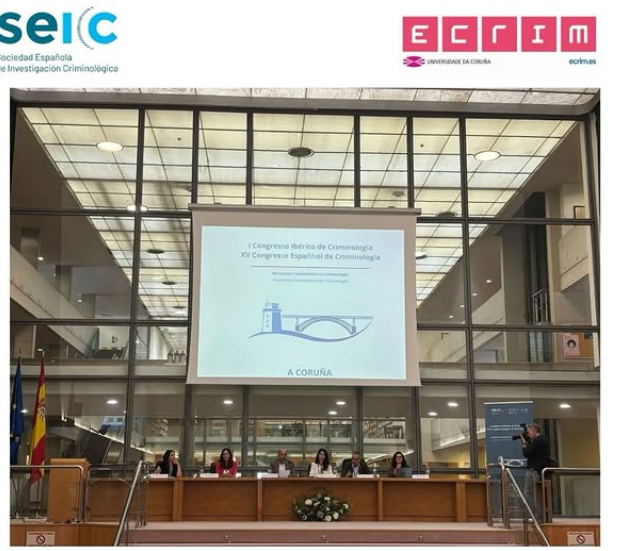
On June 10, the 1st Iberian Congress / XV Spanish Congress of Criminology (SIEC) hosted the presentation of the research paper “Repositioning the Role of ICTs and AI in Combating Human Trafficking.”
The study was conducted by Karen Latricia Hough and Noelia Gómez Bosque (Euro-Arab Foundation), Theodora Tsikrika, Despoina Chatzakou, and Theoni Spathi (CERTH), alongside Tatiana Duarte Nicolau (University of Granada), in collaboration with KU Leuven. Drawing from the findings of the Horizon Europe VANGUARD project, the research analyzed how anti-trafficking efforts have struggled to respond to the growing digital dimensions of human trafficking, while perpetrators increasingly weaponize AI and digital technologies to facilitate recruitment, coercion, and exploitation.
Based on more than 220 sources and 67 in-depth interviews with survivors, perpetrators, law enforcement, border guards, policymakers, NGOs, and experts, the study identified major vulnerabilities in current anti-trafficking responses. These include:
- Fragmentation of data systems.
- An over-reliance on reactive policing approaches.
- Limited involvement of survivors.
- Risks posed by algorithmic bias and the misuse of surveillance technologies.
The presentation also highlighted how online trafficking and poly-exploitation (which encompasses sexual exploitation, forced criminality, and labor exploitation) continue to evolve faster than many institutional responses. To address this, the VANGUARD project introduced AI-driven tools, co-developed with key stakeholders, to help anticipate and disrupt digital trafficking pathways.
However, the researchers emphasized that technology alone cannot solve systemic challenges. The presentation called for stronger human rights protections, enhanced training for front-line staff, refined regulatory frameworks, and more inclusive, survivor-centered innovation processes.
The paper concluded by advocating for a paradigm shift: moving from fragmented and reactive anti-trafficking strategies toward coordinated, evidence-based, and ethically grounded approaches that are better adapted to the realities of the digital age.
The 1st Iberian Congress / XV Spanish Congress of Criminology, organized under the slogan “Shared Horizons in Criminology” between June 10 and 12, is promoted by the Spanish Society for Criminological Research (SEIC) alongside its Portuguese counterparts. This scientific gathering serves as a strategic forum to debate the most pressing methodological, theoretical, and practical challenges within the discipline.


