


On February 27, the Euro-Arab Foundation for Higher Studies participated in the presentation of the Jihadist Terrorism Yearbook 2025, a benchmark publication edited by the International Observatory for Studies on Terrorism (OIET). This edition once again features the contribution of Daniel F. Pérez, researcher and project coordinator at the Euro-Arab Foundation.
The report, which consolidates monitoring data from the past year, reveals a significant transformation in radicalization dynamics and a shift in violence hotspots—with a particular impact on the African continent and the persistent threat within digital environments.
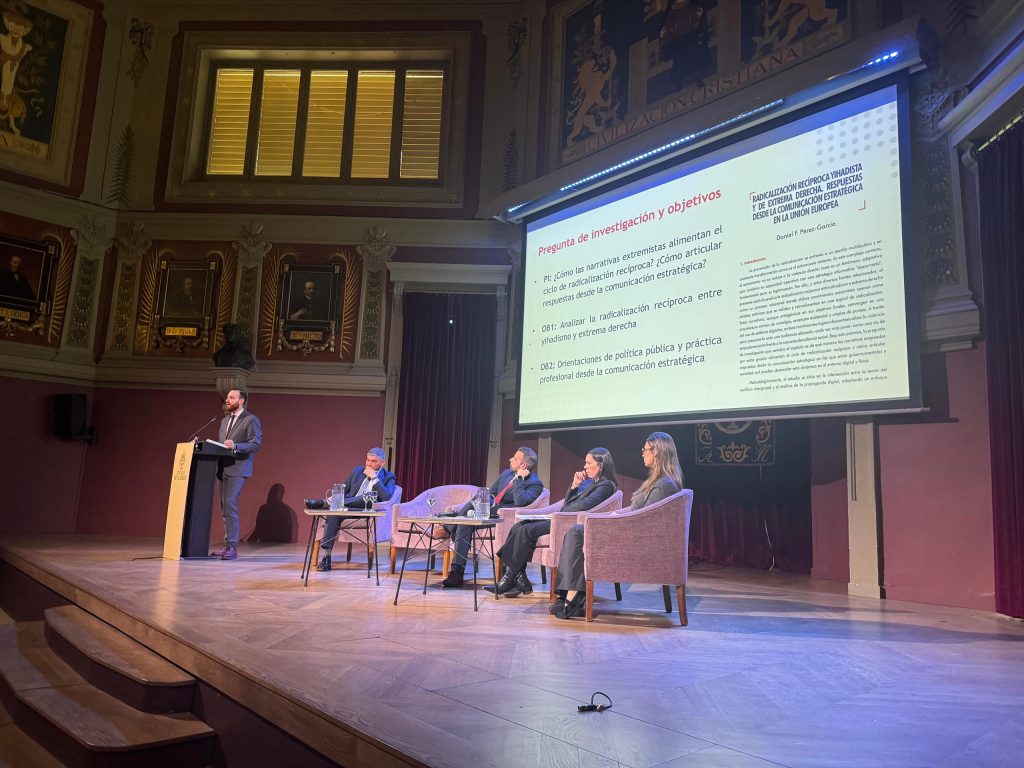
In this edition, Daniel F. Pérez-García provides a fundamental academic and strategic perspective, examining the complex relationship between Jihadism and the Far Right. The core of Pérez-García’s contribution focuses on the phenomenon of “reciprocal radicalisation,” where both extremisms operate as “rhetorical allies” that feed into each other in a vicious cycle of hatred. According to the researcher, although their ultimate goals are antagonistic, these movements converge through a shared architecture of nostalgia, existential threats, and utopias of purity.
The study highlights a concerning “mirror effect”:
- Supremacist racism is instrumentalised by Jihadism to denounce an alleged crusade against Islam.
- Radical Islamist rhetoric is used by the Far Right to justify a threat to national identity.
Ultimately, both ideologies target democratic institutions and social pluralism.
From Reaction to Resilience
As a response to this challenge, Pérez-García advocates for a transition from the current “culture of reaction” toward a “culture of resilience” based on strategic communication. He proposes an operational roadmap utilizing advanced tools, such as Artificial Intelligence for early detection and the creation of hyper-personalized counter-narratives.
“The goal is to connect emotionally with younger audiences in the digital environment before a cognitive fixation on extremist discourses occurs, thereby strengthening social cohesion against the polarization that defines the current geopolitical landscape,” states the Euro-Arab researcher.
Yearbook Links:
- Full Yearbook (Spanish): Download here
- Executive Summary (Spanish): Download here


