


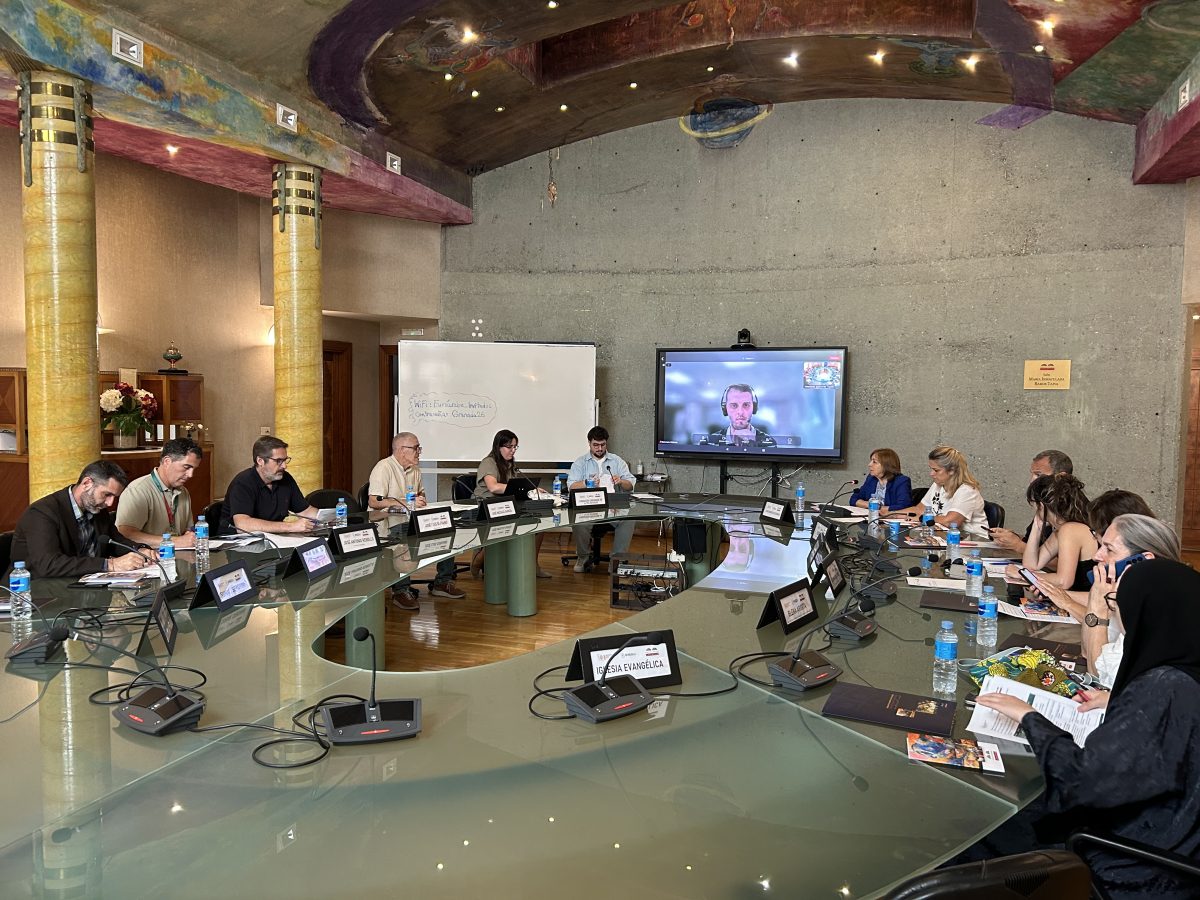
On June 9, the headquarters of the Euro-Arab Foundation for Higher Studies hosted the second meeting of the Local Working Group for the Protection of Places of Worship in Granada. This space for dialogue and intervention is co-directed and coordinated by the City Council of Granada and the Euro-Arab Foundation, within the framework of the European project SHIELDed.
The Working Group was established as one of the fundamental pillars of this European project, serving as a local, cross-sectoral platform for dialogue. Its objective is to provide institutions and religious communities with a sustainable space for exchange with civil society actors, allowing them to identify protection needs and jointly develop security and coexistence measures.
An Integrated Approach: From Physical Threats to the Digital Environment
Through a participatory approach that integrates religious communities, NGOs, public administrations, and State Security Forces, the project seeks to foster greater involvement and social cohesion. The action plan not only addresses protection against physical threats—such as vandalism or attacks on temples and worshipers—but also places a priority focus on preventing hate speech, polarization, misinformation, and social marginalization.
This second session builds on the work initiated during the kickoff meeting in December 2025. On that occasion, members of the Group had already expressed their deep concern over the rise of online hostility. Consequently, the focus of this meeting centered specifically on analyzing online discrimination and xenophobia at the national level, as well as identifying effective mechanisms and channels for reporting them.
Institutional Support and Expert Analysis
The event was opened by Amparo Arrabal, Councilor for Social Policy, Family, Disability, and Seniors, and María Eugenia Luzón Molero, technical director and coordinator of the Religious Diversity Bureau, representing the City Council of Granada. On behalf of the Euro-Arab Foundation, researchers Rascha Albaba and Javier Montilla welcomed the attendees and reviewed the activities and milestones achieved to date.
The core segment of the session was dedicated to strategies for tackling online intolerance. This featured a presentation by Mario Lara Delgado, Head of Section at the Spanish Observatory on Racism and Xenophobia (OBERAXE), under the Ministry of Inclusion, Social Security, and Migration. Lara Delgado detailed the Observatory’s work in monitoring, tracking, and reporting potentially criminal behavior on social media.
Police Cooperation and Reporting Channels
Additionally, representatives from the Security Forces participating in the Group outlined detection methods and action protocols regarding hate crimes. José Luis Soriano (National Police), Benjamín Salas (Civil Guard), and José Antonio Rebollo (Granada Local Police) delivered a joint presentation on the communication and direct reporting channels available to religious communities and the general public.
Conclusion: As the meeting drew to a close, participants agreed that discrimination and hate in the digital environment often serve as a prelude to physical assaults in real life. In this regard, they underscored the urgent need to raise awareness about the importance of reporting any discriminatory behavior and to urge authorities to act firmly against hate attacks.


