


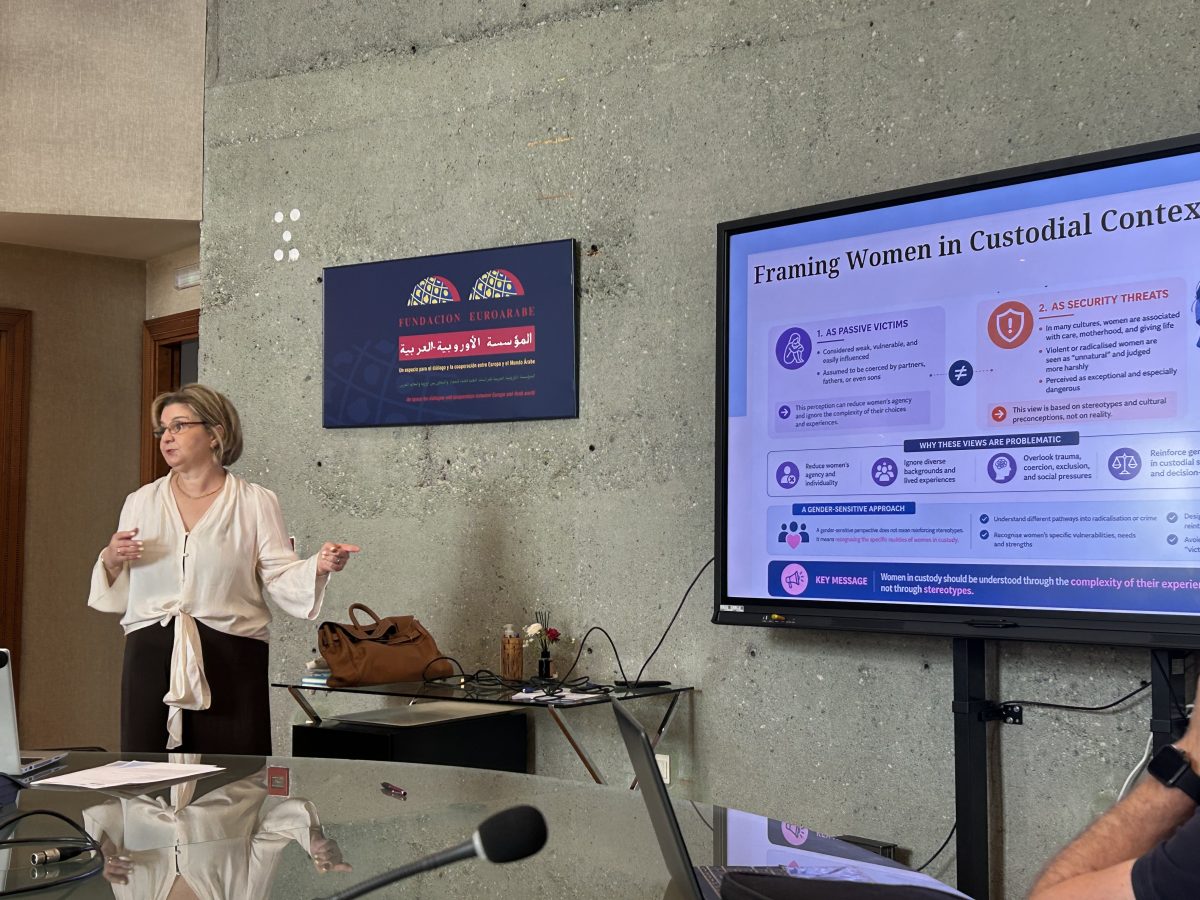
Within the framework of the European EU Mutual Job Shadowing program and in collaboration with the EU Knowledge Hub on Prevention of Radicalisation, the Euro-Arab Foundation has hosted a key technical workshop titled “Gendered Pathways from online radicalisation to custodial disengagement and reintegration.”
The event featured presentations by Dr. Chafiaa Djouadi, from the French organisation Militants des Savoirs, and Mr. Salvador Berdún, a Spanish expert in the field and head of ACAIP Research Department. Both specialists shed light on the crucial need to integrate a gender perspective into all scientific and operational research focusing on online radicalisation processes, prison stays, disengagement, and the subsequent reintegration of individuals.
Gender as a Central Axis of Radicalisation
During the session, it was emphasised that the gender perspective should not be viewed as a peripheral issue, but rather as the very core of current radicalisation dynamics, spanning from jihadism and the far-right to the incel phenomenon. According to the experts, radicalised women often operate as recruiters, facilitators, or ideological support within these networks, though frequently under dynamics of subordination to men, a factor that requires meticulous analysis to formulate effective responses.
Furthermore, the speakers agreed that psychological care and guidance during the disengagement process, which necessarily begins within the correctional environment, must have guaranteed continuity outside of prison. This transition is essential to ensuring a real, effective, and long-term social reintegration.
By hosting this technical seminar, the organizing institutions reaffirm their commitment to advancing public safety and evidence-based social intervention, placing the gender perspective as a priority axis in the design of policies for preventing violent radicalisation (PVE/CVE).


