Categories
VANGUARD

The Euro-Arab Foundation brings its work on AI and human trafficking to the University of Brescia

The Euro-Arab’s researcher, Karen Hough, contributed to the doctoral programme reflects the importance of interdisciplinary research and academic exchange

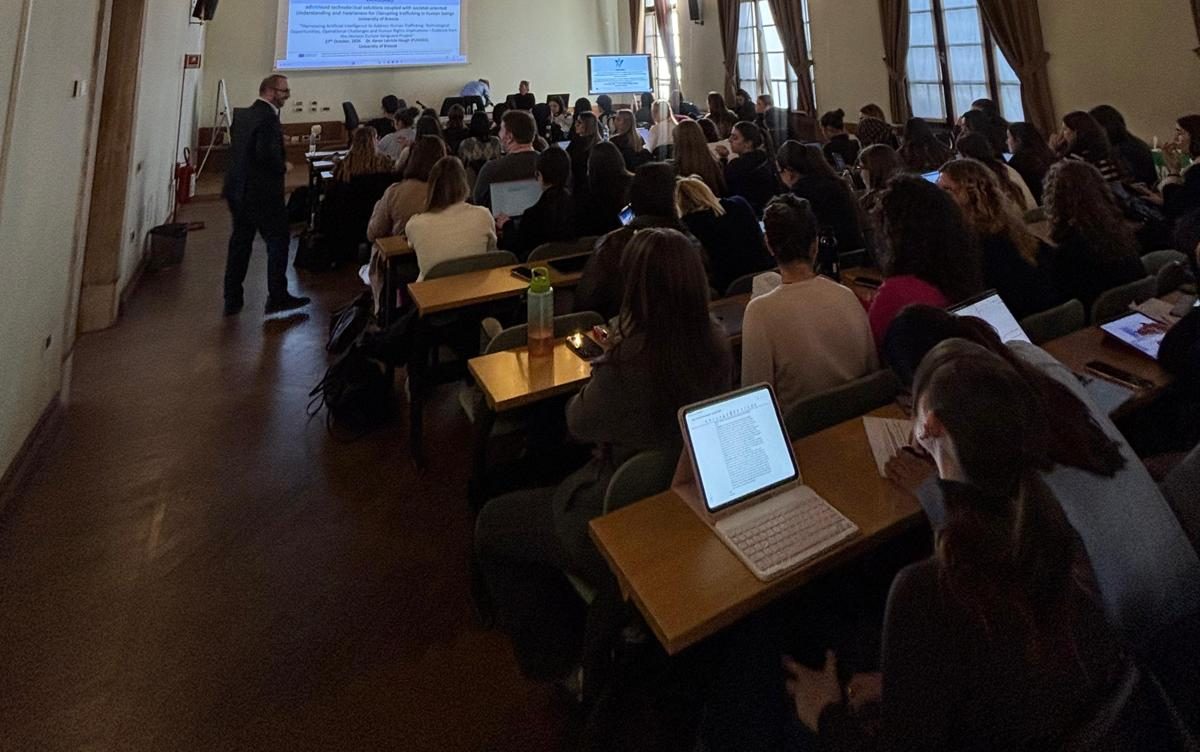
On 27 October, Karen Latricia Hough, researcher at the Euro-Arab Foundation , delivered a presentation at the University of Brescia (Italy) as part of the PhD Programme ‘Rights, Person, Innovation and Market’; hosted by the Department of International Law .

The lecture, entitled ‘Harnessing Artificial Intelligence to Address Human Trafficking: Technological Opportunities, Operational Challenges and Human Rights Implications—Evidence from the Horizon Europe Vanguard Project’, explored the growing role of artificial intelligence (AI) in tackling human trafficking, as well as the opportunities and challenges of deploying emerging technologies against it.

Drawing on evidence from the Horizon Europe Vanguard Project, Hough examined how AI-powered tools and technological innovation can strengthen efforts to identify, prevent and respond to human trafficking. She also addressed the operational challenges of implementing these technologies, alongside the critical human rights considerations that must guide their development and use.

As AI continues to reshape approaches to security, justice and human rights protection, the discussion highlighted the importance of ensuring that technological solutions are effective, ethical and grounded in human rights principles. It also underscored the need for collaboration between researchers, policymakers, legal experts and practitioners to ensure that innovation translates into meaningful, responsible action against human trafficking.

The importance of ensuring that technological solutions are effective, ethical and grounded in human rights principles

Hough’s contribution reflects the value of interdisciplinary research and academic exchange in addressing pressing global challenges at the intersection of technology, international law, human rights and social protection. This visit also gave the Euro-Arab Foundation the opportunity to share the Horizon Europe VANGUARD Project with the academic community and to contribute to the debate on how emerging technologies can support more effective and human-rights-centred responses to human trafficking.

Innovation in human rights protection

For the Euro-Arab Foundation, this participation is part of the ongoing analysis of AI as a technology with a dual nature: it can be misused by criminal networks but it can also propels the protection of trafficking victims The doctoral programme, which combines cultural, technological and methodological innovation, is closely aligned with VANGUARD, particularly with the design of ‘Red Flags: a serious game’, a video game for children and teenagers that takes into account their environment: family, educators, friends and social communities.

VANGUARD project, which concluded on October with a final conference at the Center for Security Studies (KEMEA), puts in practice innovation not only on the process of developing tools, but also in how to ensure the accessibility of these tools reinforced by the design of engagement and awareness actions, with the involvement of science communicators with a more approachable and age adequate to the targets digital languages.


Categories
VANGUARD VANGUARD

The Euro-Arab Foundation leads the awareness-raising and dissemination campaign for the video game ‘Red Flag’

The Euro-Arab Foundation leads the awareness-raising and dissemination campaign for the video game ‘Red Flag‘, designing a key action to strengthen its educational impact and its level of socio-community outreach among young people and adolescents, as potential victims of human trafficking networks, both online and offline. To this end, the Foundation collaborates with psychologist Isabel Duque, a professional who works with the virtual codes and interactive languages used in the digital spaces that minors engage with on a daily basis.

The campaign design began at the start of the year and concluded at the end of September. It consisted of identifying candidate profiles and assessing them against rigorous suitability criteria, given the high sensitivity of the subject matter and of the target audience: minors and their closest support networks. The criteria included a significant social media presence, assessed not only by number of followers but also by the size and characteristics of their digital communities, that is, by the profile of the users who trust the judgement of the person disseminating the content. In addition, profiles were required to focus their content on social justice (given the subject of human trafficking), a gender perspective (as the ‘lover boy’ method targets, and its victims are, women and girls), and the education of minors, as this is a free public-service action.

Following several months of outreach to a range of professionals, always under the coordination and supervision of the Euro-Arab Foundation, and in partnership with the German association specialised in combating human trafficking, Gemeinsam gegen Menschenhandel e.V. (GGMH), the first design phase of the prevention campaign for adolescents concluded when Isabel Duque, a psychologist better known as ‘La Psicowoman‘, agreed to collaborate with the Foundation. Ms Duque has a professional career spanning more than two decades, delivering lectures, facilitating workshops and maintaining a proactive online presence across several digital platforms, including TikTok and Instagram, which are widely used by adolescents. She is also the author of several books on emotional education and prevention, and focuses her work on in-person sessions delivered in schools and secondary education centres throughout Spain.

Finally, as a reinforcement of the ‘Red Flag’ campaign, a serious game against the recruitment of minors on social media and in their everyday lives, which remains ongoing, the collaboration with Isabel Duque took place on Monday 28 and Wednesday 30 October. It achieved more than 200 likes and over 9,200 views within three days (a figure that continues to grow), with a potential reach of nearly 82,000 followers.

Categories
News VANGUARD VANGUARD

Red Flags: a serious game against child trafficking developed by VANGUARD

Accessible online for all audiences

The VANGUARD project, focused on developing technological solutions against human trafficking, has launched the game ‘Red Flags’, whose development involved the Euro-Arab Foundation in the design and oversight of the content script, a key piece given that it is an interactive, role-based game built around a series of dialogue sequences.

VANGUARD is a highly innovative, interdisciplinary project running over three years, involving a total of twenty-two partners from twelve countries, and backed by €4.5 million in funding. Part of this budget has been allocated to ‘Red Flags’, a serious game that adopts an engaging format prioritizing broad, straightforward accessibility aimed at social and educational professionals as well as parents and adolescents.

The goal is to educate people about one of the most common strategies used to recruit victims: the ‘loverboy’ method and the ‘love bombing’ tactic, which use supposed romantic relationships to attract, persuade, and ultimately subdue those who end up in a situation of risk until they are sexually exploited.

A campaign against the recruitment of minors through social media

The ‘Red Flags’ campaign has been designed for social media with one of the groups at highest risk of being recruited online in mind: adolescents and minors. Using accessible language, an informal style, and a series of short videos shared on the channels that are part of this population segment’s everyday life, ‘Red Flags’ is being introduced to young people in Spanish, English, German, Italian, Portuguese, and Greek.

Categories
News Projects VANGUARD

Vanguard Project Shares Groundbreaking Anti-Trafficking Research at KU Leuven Workshop

On 16the June, researchers from the Vanguard project convened a hybrid workshop at KU Leuven University presenting the latest findings from their academic research on the prestigious Horizon Europe anti-trafficking initiative.

The workshop featured a presentation by Karen Hough from the Euro-Arab Foundation and Teresa Forlitti from Hart and Stand in the United States about their collaborative paper, “Creating sustainable models for the inclusion of lived experience experts in anti-trafficking preventative measures and policy making: insights from the Vanguard project”.

Attended by a diverse group of experts, including representatives from the European Commission, academia, and NGOs, the workshop fostered a highly productive and formative discussion. The research results were very well received, highlighting the project’s impact in the fight against human trafficking.

The Vanguard project, a European-financed initiative, is dedicated to strengthening the combat against human trafficking (THB). It achieves this by providing an improved intelligence picture, delivering an advanced and trustworthy suite of tools, and implementing innovative training activities.

Further workshops are planned in the coming months to continue sharing the project’s vital research and foster ongoing collaboration.

Categories
News Projects VANGUARD

The Euro-Arab Foundation Highlights the Role of Ethical AI in the Fight Against Human Trafficking at High-Level Conference in Malta

The Euro-Arab Foundation for Higher Studies participated in the “Empowering Change: Technology and AI in the Fight Against Human Trafficking” Conference, held on June 11, 2025, in Malta. The event, organized under the Maltese Presidency of the Committee of Ministers of the Council of Europe, brought together experts and global leaders to explore the potential of artificial intelligence (AI) in eradicating this heinous crime.

During the conference, Karen Latricia Hough, researcher at the Euro-Arab Foundation, presented the innovative Horizon Europe Vanguard project in a crucial panel titled “AI and Human Rights.” Hough’s intervention underscored Vanguard’s commitment to developing technological tools that, in addition to being highly effective, strictly adhere to legal and ethical principles.

The conference served as a vital platform for dialogue among governments, international organizations, law enforcement agencies, academia, and civil society. Key topics addressed included the use of innovative technologies to dismantle trafficking networks, the human rights implications of AI use, and the need to foster intersectoral partnerships for a more robust global response.

Among the invited speakers were Professor Siobhán Mullally, UN Special Rapporteur on Trafficking in Persons and Director of the Irish Centre for Human Rights; the OSCE Special Representative and Coordinator for Combating Human Trafficking; and Petya Nestorova, Executive Secretary of GRETA. The conference was attended by law enforcement agents, academics, experts, and representatives from NGOs. In particular, Dr. Hough discussed how the research team is ensuring that the technological tools created in the Vanguard project align with legal and ethical requirements.

The date coincided with the 20th anniversary of the Council of Europe Convention on Action against Trafficking in Human Beings, reaffirming the commitment of member states to innovative, rights-based responses in the evolving digital environment. This landmark instrument aims to ensure that AI technologies are developed and deployed in ways that fully respect democratic values, protect human rights, and uphold the rule of law – including in the crucial fight against trafficking in human beings.

VANGUARD Consortium Meeting

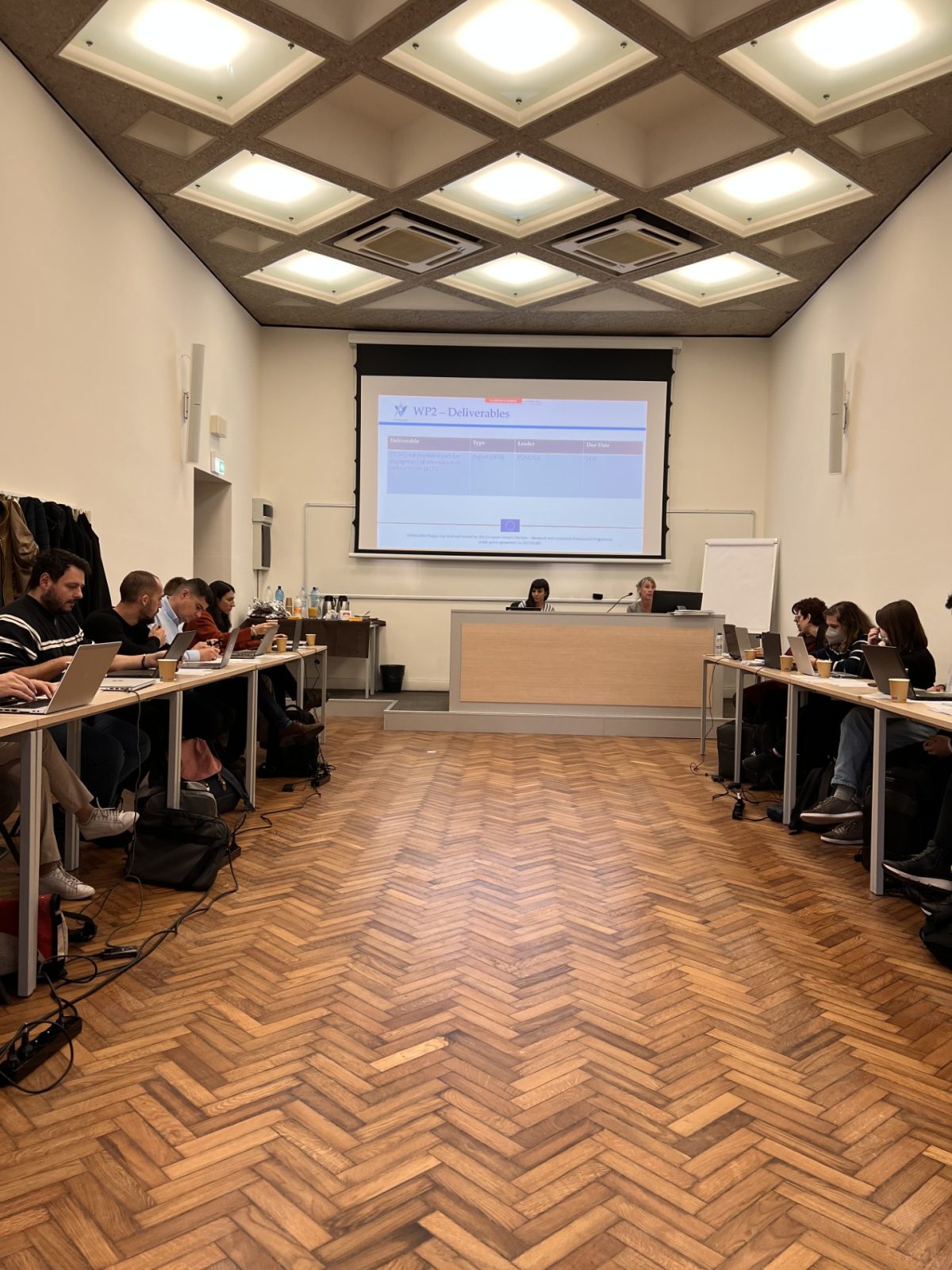
Researchers from the Euro-Arab Foundation attended the fourth VANGUARD consortium meeting in Lisbon to discuss the results of the Horizon Europe Vanguard project. The event took place at the judicial police office in Lisbon, where technological tools, including facial recognition and emotion recognition tools, were showcased. Researchers also discussed in depth the next steps for the project, which include policy roundtables and publications.

Categories
Intercepted News Projects

Multi-agency work and cross-border cooperation: keys to the fight against trafficking in persons

On Thursday 19 September, the INTERCEPTED and OSINT-RADAR projects jointly organised a seminar for law enforcement agencies (LEAs), judiciary and prosecutors. The event, held physically in Tirana (Albania), but in a hybrid format, discussed key aspects of human trafficking, such as public-private cooperation in the fight against trafficking and other crimes such as smuggling of migrants or drug trafficking. The professionals and experts participating in this event placed special emphasis on the analysis of the phenomenon in the Balkans and Eastern Europe and its relationship with the European Union, although experiences located on other routes, such as those of the Central Mediterranean, were also analysed. The access routes from the Balkans to the EU were also analysed, highlighting the geographical value of Trieste (Giulia-Venice-Julia), Bari (Apulia), Slovenia and Albania as key points. In this context, different experiences of cooperation between EU countries and the Balkans, especially between Albania, Italy and Slovenia and, to a lesser extent, France and Spain, were presented and discussed.

In the presentations and discussions, the possible interrelation of the phenomenon of trafficking with other crimes, both online and offline, was analysed. The key role of multi-agency work, cross-border cooperation between different bodies (LEAs, prosecution and judiciary) and the desirability of establishing cooperation agreements between them, both nationally and internationally, was also highlighted.  Many of the interventions underlined the benefits of transferring experiences and techniques from the investigation of other crimes, as is the case of the follow-the-money-approach. The key role of digital tools in the fight against this phenomenon and other criminal activities in which organised crime operates was also discussed.

The next INTERCEPTED seminar on digital trafficking, co-organised by the ASIT project, also of a hybrid nature, will be held on 13 November and will mainly target internet providers and experts in digital tools.

Categories
News Projects VANGUARD

FUNDEA’s researchers present VANGUARD in Laurea University in Helsinki

On the 12th September 2024, researchers from the Euro-Arab Foundation in Granada, Spain presented Vanguard, an EU funded Horizon Europe focused on the prevention and detection of Trafficking inhuman beings as part of the crime prevention module at Laurea University of Applied Sciences in Helsinki. Over 25 students and stakeholders attended the three-hour hybrid session, which focused on both online and offline cases and detection methods. The researchers presented the unique approach of Vanguard, which encompasses the state of art creation of artificial intelligence to be used at land, sea and air borders, coupled with societal awareness.

Researchers also presented statistics and case studies from Spain, outlining how often national citizens are victims of this heinous crime. They also highlighted the need for the inclusion of survivors in both preventative measures and policy making.

Categories
News Projects VANGUARD

VANGUARD consortium meets to share results

On April 22nd and 23rd, the entities associated in the VANGUARD project, financed by the Horizon Europe – Cluster 3 program “Civil security for society” whose objective is to strengthen the fight against Trafficking in Human Beings (THB) and in which the Euro-Arab Foundation for Higher Studies participates, meet in Milan (Italy).

The Euro-Arab Foundation’s researcher Karen L. Hough participates in the meeting with the paper VANGUARD Road Ahead: Good practices for engagement of relevant actors and THB survivors: status, main activities and next steps, a discussion on cooperation with Civil Society Organizations and THB survivors, and the inclusion of their voices for three purposes: understanding, dismantling and raising awareness.

This second meeting of VANGUARD consortium also addresses aspects such as the current situation of online and offline THB crime and the next steps to be taken, the legal and ethical framework of VANGUARD and the validation of the project tools through pilot. Artificial Intelligence will serve as a tool for detection, identification, investigation and prevention of THB online and offline (e.g. at border checkpoints), applying computer vision and multimodal analysis.

The twenty-two members of VANGUARD consortium are expected to complete in 2026 this project that will enable to tackle one of the most serious transnational crimes, Trafficking in Human Beings, whose most predominant purpose within the European Union is sexual exploitation, followed by labour exploitation1.

  1. https://home-affairs.ec.europa.eu/policies/internal-security/organised-crime-and-human-trafficking/together-against-trafficking-human-beings_en ↩︎
Categories
EN Bigosint News Projects

The Euro-Arab Foundation will participate in the final conference of BIGOSINT against trafficking in human beings

On 3 April, BIGOSINT, a project funded by the European Commission’s Internal Security Fund, will conclude two years of work to combat human trafficking through the analysis of Big Data and OSINT (Open Source INTelligence) at a conference in the Italian city of Bologna. The event will be attended by representatives of the four partners that have developed this European project: the Public Prosecutor’s Office of the Ordinary Court of Trento (Italy), coordinator of the project, Agenfor International (Italy), the University for Public Administration in Bremen (Germany) and the Euro-Arab Foundation for Higher Studies (Spain).

Sergio Bianchi, Director of the Agenfor International Foundation, will be in charge of the opening with an overview of the project, the risk assessment in the cycle of smart tools for information collection and, together with Rihab Ben Ammar, the analysis of new human trafficking routes.

Afterwards, Marijke Paulien Van Reijsen from MBS Engineering will present an analysis and explain the use of FAST Data, a real-time Big Data process, in the context of preventing and breaking human trafficking networks. Gianni Franzoi, Senior Commissioner of the Venice Local Police, will give his experience with the multi-agency cooperation model and new tools and Yuval Sanders, Managing Director of Falkor Ltd., will give an overview of public-private prevention with a hands-on practice on the TANGLES platform.

In the afternoon session, Emanuele Florindi, an IT lawyer, will present applications for monitoring the financial activity of traffickers in cyberspace. José González Riera, researcher at the Euro-Arab Foundation for Higher Studies and José Martínez Marín, from the Local Police of Murcia; Trygve Ben Holland, from the University for Public Administration in Bremen; Ivan Stenico and Nicola Cordeschi from the Public Prosecutor’s Office of the Ordinary Court of Trento will present cases of trafficking in human beings for sexual exploitation, the investigation of online crime and the indicators (red flags) of trafficking.

The event will conclude with the presentation of the Social Engagement Report: Overview and Results by Naz Öztürk, Project Manager and OSINT Analyst at Agenfor International.

The final conference, which will be simultaneously interpreted English-Italian-English, can be followed online, for which registration is required: https://forms.gle/bfX6LDzD3YazbJ7U9

More information on the project: https://projects.fundea.org/bigosint/